
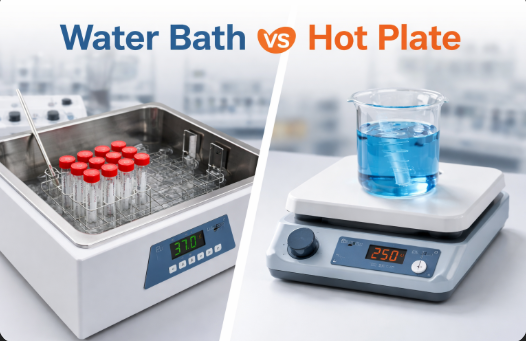
When it comes to laboratory heating methods, choosing between a water bath vs hot plate can significantly impact your results. Both tools are widely used in research and chemistry laboratories, but they differ in temperature control, safety, and applications.
In this guide, we compare water bath vs hot plate performance, advantages, and real laboratory use cases to help you choose the best option for your specific needs.
Water Bath vs Hot Plate: Key Difference
| Feature | Water Bath | Hot Plate |
|---|---|---|
| Heating Method | Indirect (water-based heating) | Direct surface heating |
| Temperature Control | Highly stable and uniform | Less uniform |
| Maximum Temperature | Up to ~100°C | Can exceed 300°C |
| Best For | Biological samples, incubation | Chemical reactions, boiling |
| Safety | Safer, lower risk of overheating | Higher risk of burns/overheating |
When to Use a Laboratory Water Bath
A laboratory water bath is ideal when gentle, uniform heating is required. It is commonly used for sample incubation, enzyme reactions, and temperature-sensitive experiments where precise control is critical.
To explore suitable models, check our guide to the best laboratory water baths for research labs.
When to Use a Hot Plate in the Laboratory
A hot plate is better suited for applications requiring high temperatures or rapid heating. It is widely used in chemistry laboratories for boiling liquids, evaporation, and general heating tasks.
Pros and Cons of Water Bath vs Hot Plate
Water Bath Pros & Cons
Pros: uniform heating, safer operation, ideal for sensitive samples
Cons: limited maximum temperature, slower heating
Hot Plate Pros & Cons
Pros: higher temperatures, faster heating, versatile use
Cons: less uniform heating, higher risk of overheating
For general laboratory safety practices, refer to laboratory safety guidelinesWhich One Should You Choose?
If your work involves biological samples or requires precise temperature control, a laboratory water bath is the better choice. However, for high-temperature applications and faster heating, a hot plate is more suitable.
For most laboratory applications requiring stable heating, a water bath is often the preferred option. You can compare top models in our guide to the best laboratory water baths for research labs.
Common Mistakes When Choosing Between a Water Bath and Hot Plate
One common mistake is choosing a hot plate for temperature-sensitive samples that require uniform heating. Another mistake is using a water bath when higher temperatures are needed. Understanding the limitations of each device helps prevent experimental errors and improves efficiency in the laboratory.
If you are new to using water baths, you can follow our step-by-step guide on how to use a laboratory water bath for better results.
Conclusion
Choosing between a water bath and a hot plate depends on your laboratory requirements, sample sensitivity, and temperature range. For precise and uniform heating, a water bath is often the better choice, while a hot plate is more suitable for high-temperature and rapid heating applications.
Frequently Asked Questions
Yes, a water bath is generally safer because it provides indirect heating and reduces the risk of overheating or burning samples.
Not always. A hot plate cannot provide the same level of uniform and controlled heating as a water bath.
The main advantage is precise and uniform temperature control, which is essential for sensitive laboratory experiments.