
Introduction
Choosing the best orbital shakers for laboratory research is not as straightforward as it looks. In real lab environments, performance depends on more than just speed — factors like orbit size, load capacity, stability during long runs, and compatibility with incubators or cold rooms can significantly impact your results.
Whether you are working with cell cultures, microbiology samples, or chemical mixing, selecting the right orbital shaker can improve consistency and reduce experimental errors. In this guide, we compare the top orbital shakers in 2026 and help you choose the right model for your lab workflow.
For other essential lab heating and mixing equipment, you may also want to explore our guide on best laboratory water baths for research labs .
Best Orbital Shakers for Laboratory Research – Quick Comparison (2026)
Finding the best orbital shakers for laboratory research can be challenging, especially when different models offer similar specifications. Before going to the in-depth review in the next section, this comparison table simplifies the process by highlighting the key differences that actually matter in real lab environments.
Use this quick overview to compare speed range, load capacity, and unique features, and identify which shaker is best suited for your specific application — from high-capacity mixing to low-noise or incubator-based workflows.
| Model | Best For | Speed Range | Orbit Size | Capacity | Special Feature | price |
|---|---|---|---|---|---|---|
| 4E’s USA Orbital & Linear Shaker | Multi-purpose labs | 20–500 rpm | Not specified | 7.5 kg | Dual shaking modes (orbital and linear) | |
| Digital Orbital Shaker with Platform | Quiet lab environments | 100–500 rpm | Not specified | 7.5 kg | Brushless DC motor for low-noise operation | |
| ONiLAB Digital Orbital Shaker (7.5 kg) | Best value for money | 100–500 rpm | Not specified | 7.5 kg | Includes universal platform | |
| JOANLAB OS-20PRO | Incubator use and gentle mixing | 40–200 rpm | 20 mm | Not clearly specified | Compact design for incubator compatibility | |
| ONiLAB Digital Orbital Shaker (2 kg) | Classrooms and light-duty use | 40–200 rpm | Not specified | 2 kg | Compact, affordable, replaceable platform |
While the table gives you a quick overview, the real differences become clearer when you look at how each shaker performs in actual lab workflows. Let’s break them down one by one.
Detailed Review of the Best Orbital Shakers for Laboratory Research
Choosing the best orbital shakers for laboratory research requires more than just comparing specifications on paper. In real lab conditions, factors such as stability during long runs, noise levels, load handling, and ease of use can significantly affect your results. In the following section, we take a closer look at each model to evaluate how it performs in practical workflows — helping you identify which shaker truly fits your laboratory needs.
For applications requiring magnetic mixing instead of shaking, you may also find this guide helpful: top non-heating magnetic stirrers for laboratory use .
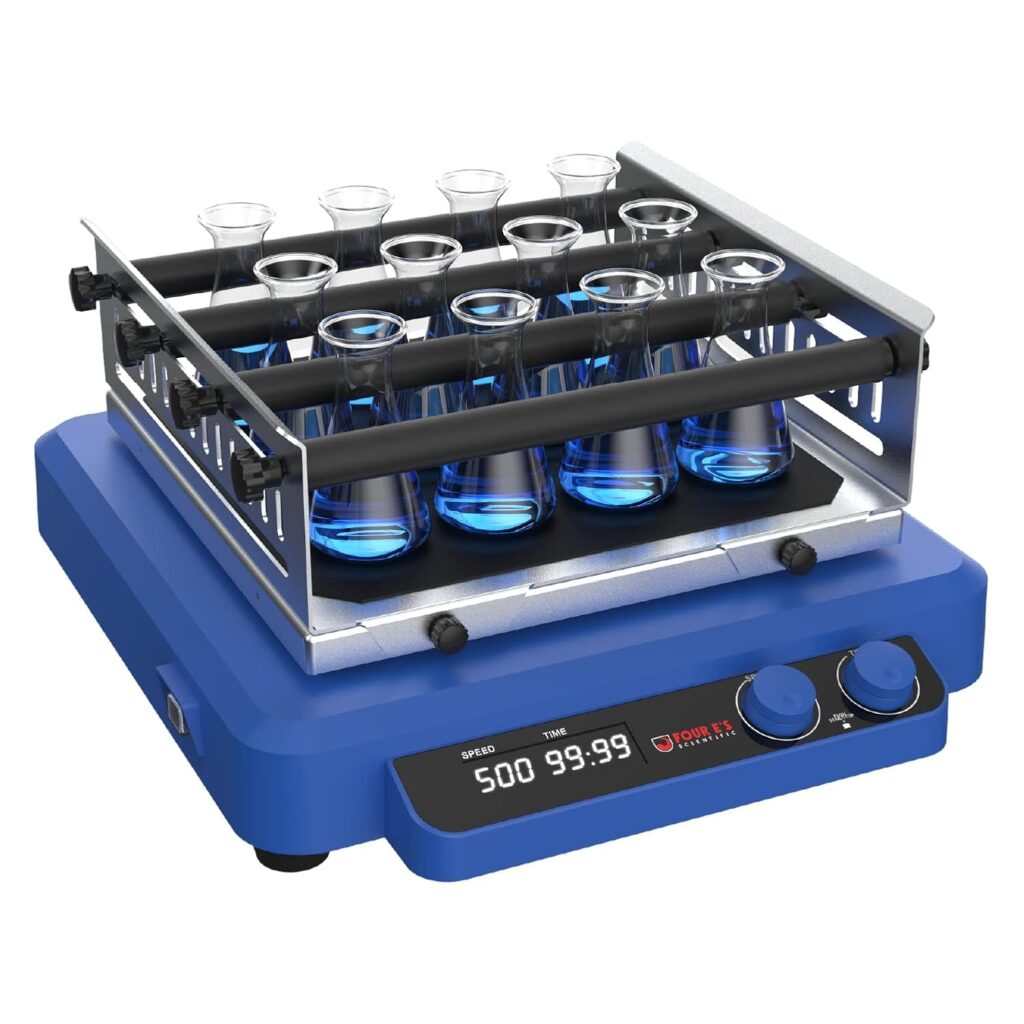
1. 4E’s USA Orbital and Linear Shaker
If your lab workflow involves different types of mixing, the 4E’s USA Orbital and Linear Shaker is a highly flexible option. Unlike standard models, this unit allows you to switch between orbital and linear motion, making it suitable for a wider range of experimental setups.
With a broad speed range of 20–500 rpm and a strong 7.5 kg load capacity, it performs well in both routine and more demanding research environments. The digital control system ensures stable motion, even during long runs.
Key Features:
- Dual shaking modes (orbital & linear)
- Speed range: 20–500 rpm
- Load capacity: up to 7.5 kg
- Timer: up to 100 hours with automatic alarm
- LED display for speed and time monitoring
- Overload and overspeed protection
Pros:
- Highly versatile for different lab applications
- Higher load capacity than many benchtop models
- Stable operation with minimal splashing
- Reliable safety features for long experiments
Cons:
- Bulkier than compact orbital shakers
- Dual-mode function may be unnecessary for simple tasks
Lab Performance Insight: In real lab use, the dual-mode functionality offers practical advantages. Orbital motion is ideal for general mixing and culture work, while linear shaking can improve interaction in applications where directional movement matters.
Best For: University labs, multi-purpose research environments, and workflows requiring both gentle mixing and directional agitation.
🔴🔗price: Check current price of the 4E’s USA Orbital and Linear Shaker on Amazon
2. Digital Orbital Shaker with Platform (100–500 rpm)
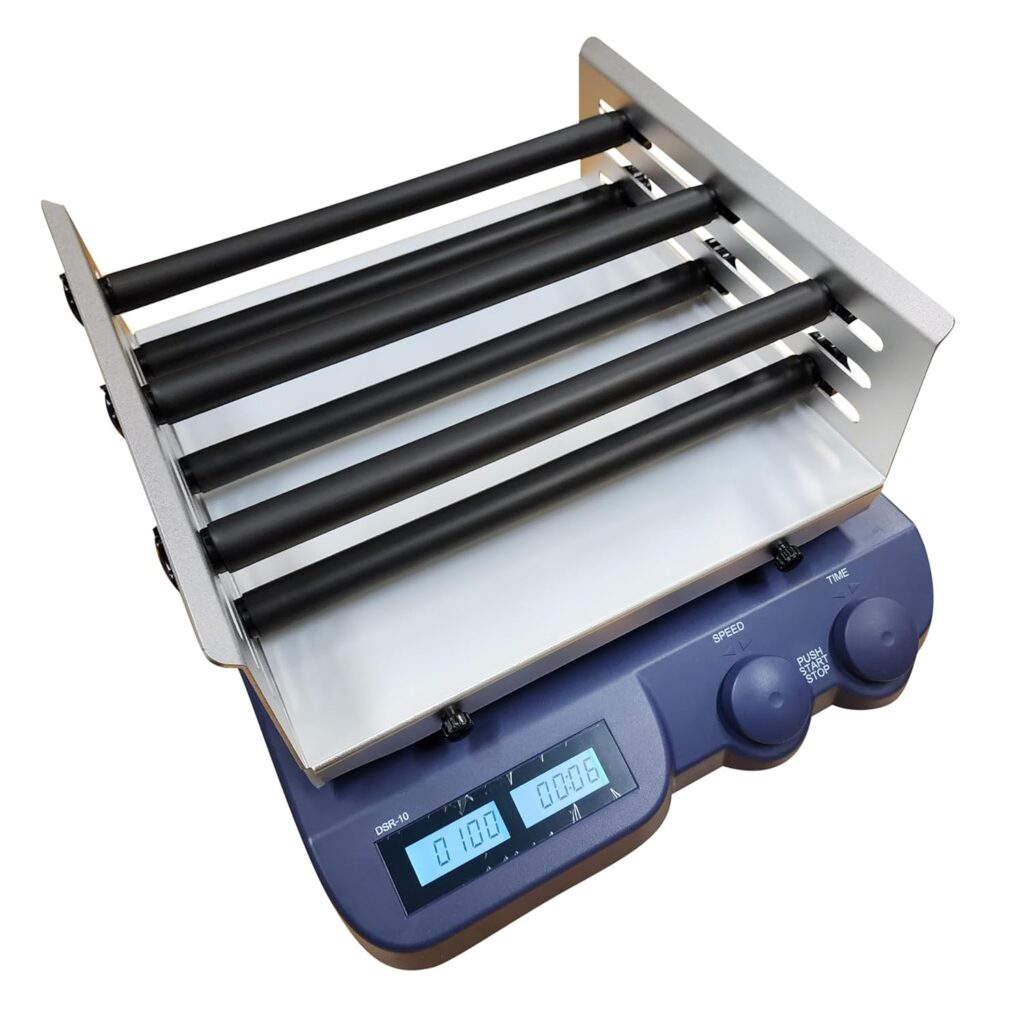
The Digital Orbital Shaker with Platform is a solid mid-to-high range option designed for stable and low-noise performance. With a brushless DC motor, it can run smoothly for extended periods, making it suitable for long experiments where consistency matters.
This model supports both orbital (circling) and reciprocating motion, giving users more flexibility depending on the application. Its digital interface allows accurate control of speed and time, which is particularly useful in reproducible research workflows.
Key Features:
- Speed range: 100–500 rpm
- Dual motion modes (orbital & reciprocating)
- Maximum load: 7.5 kg (net payload ~5.9 kg)
- Brushless DC motor for quiet, long-term operation
- Digital control with backlit LCD display
- Timer and speed precision settings
- Built-in safety protection system
Pros:
- Very quiet operation, ideal for shared lab spaces
- Accurate digital control for reproducibility
- Stable performance during long runs
- Good balance between performance and capacity
Cons:
- Less brand recognition compared to major manufacturers
- Limited advanced features beyond core functions
Lab Performance Insight: In practice, the brushless motor makes a noticeable difference during extended experiments. Reduced vibration and lower noise levels help maintain stability, especially when working with sensitive samples or running overnight protocols.
Best For: Research labs, microbiology workflows, and applications requiring quiet, stable, and repeatable mixing conditions.
🔴🔗price: Check latest price & availability on Amazon
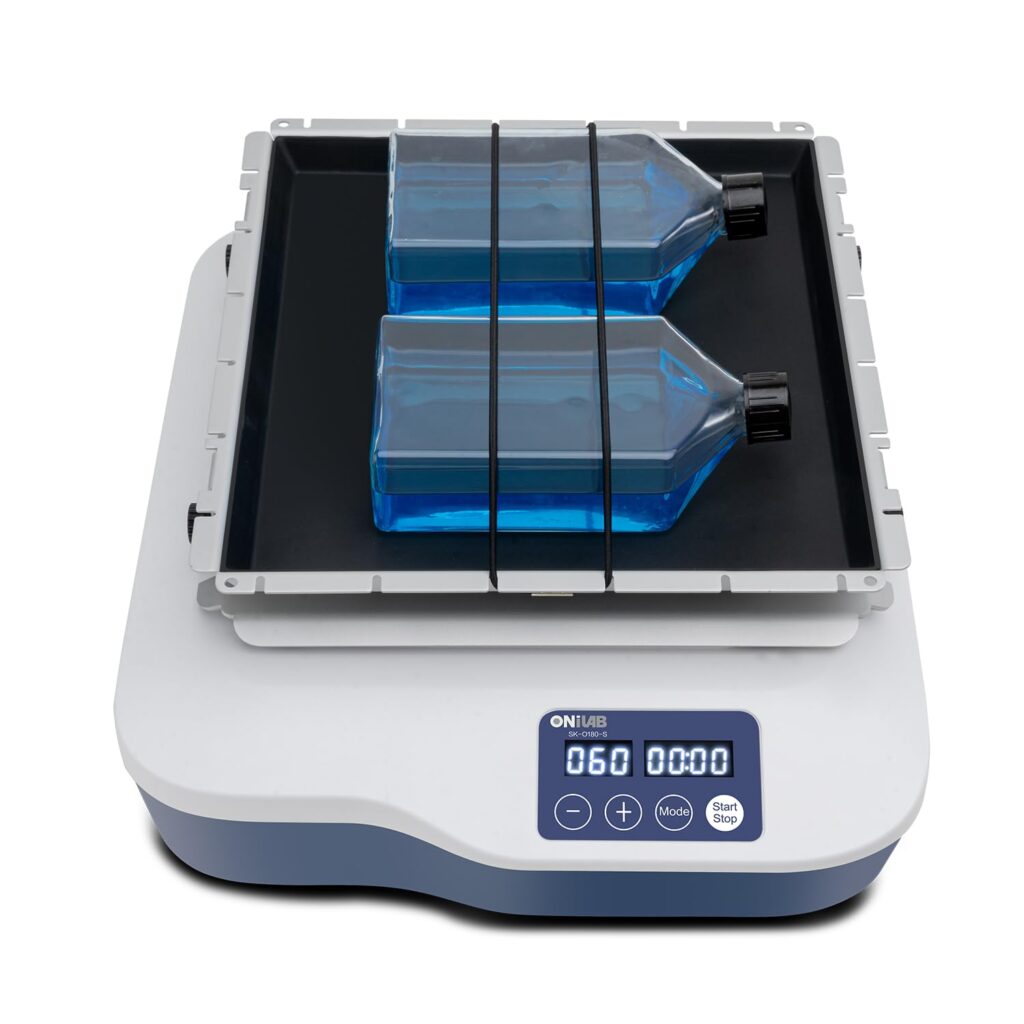
3. ONiLAB Digital Orbital Shaker (100–500 rpm, 7.5 kg Capacity)
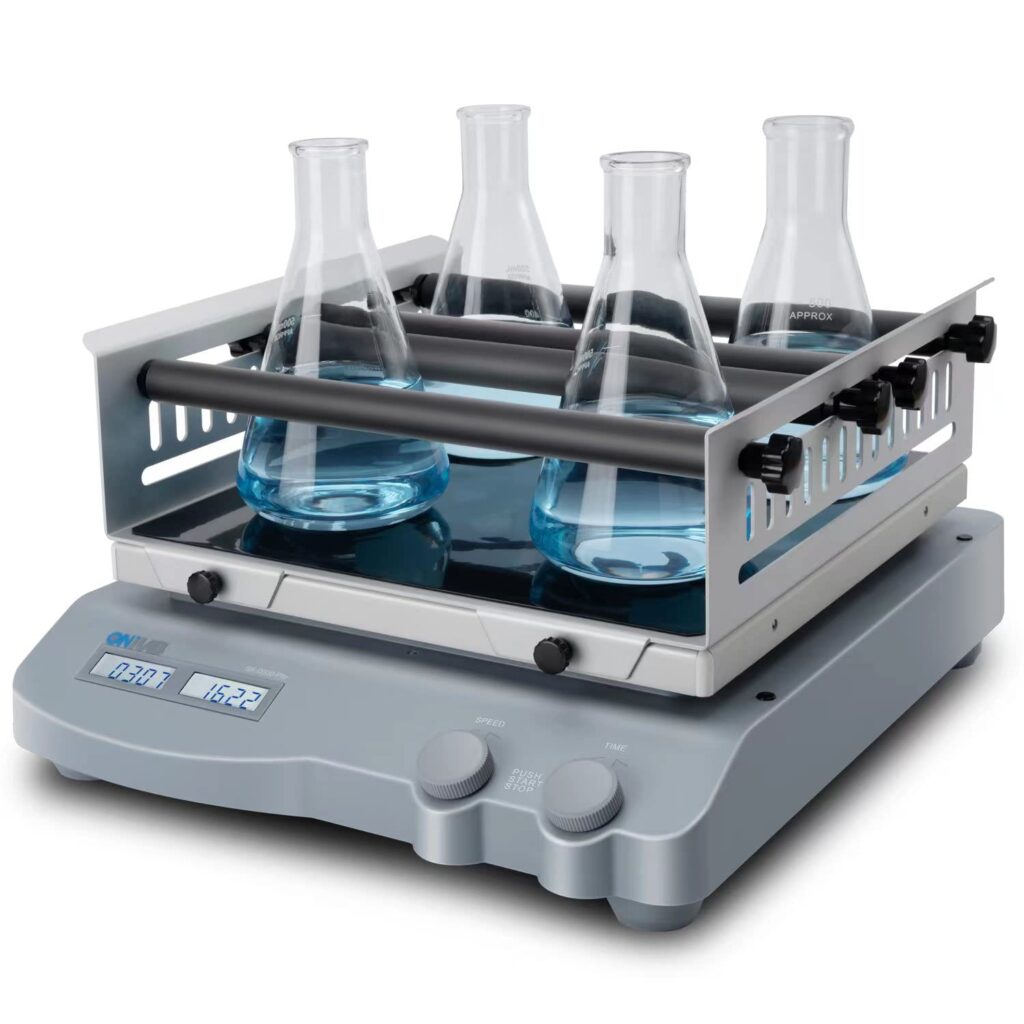
The ONiLAB Digital Orbital Shaker offers a strong balance between affordability and functionality. With a speed range of 100–500 rpm and a solid 7.5 kg capacity, it is well-suited for routine laboratory applications, including microbiology, chemistry, and general sample mixing.
Its compact design makes it easy to place on crowded lab benches, while the digital LCD interface allows precise control over speed and timing. The inclusion of a universal platform adds immediate usability without needing extra accessories.
Key Features:
- Speed range: 100–500 rpm
- Load capacity: up to 7.5 kg
- Timer: 1 min to 99h 59min + continuous mode
- Brushless DC motor for stable, long-term operation
- LCD display for speed and time control
- Over-speed protection for safe use
- Corrosion-resistant ABS construction
- Includes universal platform (320×320 mm)
Pros:
- Excellent value for the price
- Quiet and stable performance
- Comes with a usable platform out of the box
- Compact and space-efficient design
Cons:
- Fewer advanced features compared to premium models
- Additional platforms must be purchased separately
Lab Performance Insight: In everyday lab use, this shaker performs consistently with minimal vibration, especially when running standard flask sizes. The included platform is a practical advantage, allowing immediate setup without additional purchases.
Best For: University labs, small research setups, and users looking for a reliable yet budget-conscious orbital shaker.
🔴🔗price: Check latest price & availability on Amazon
4. JOANLAB OS-20PRO Orbital Shaker (40–200 rpm)
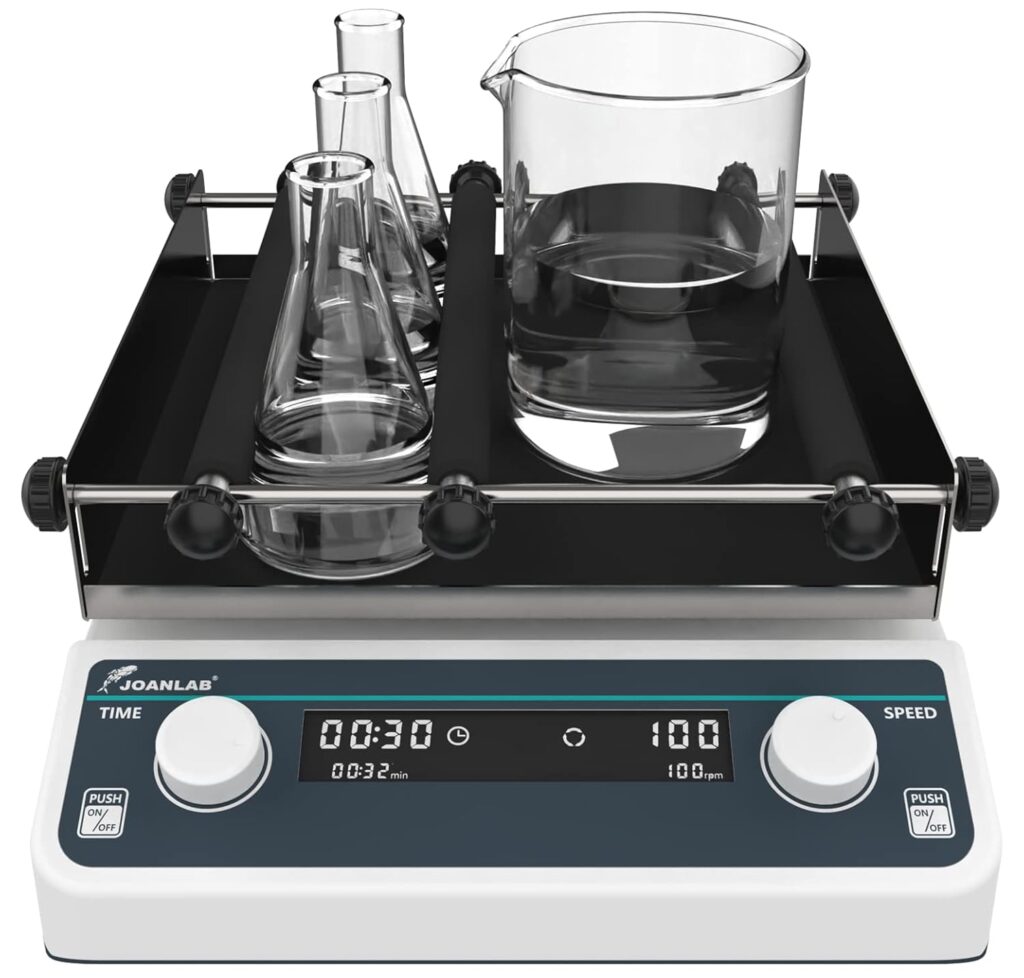
The JOANLAB OS-20PRO Orbital Shaker is designed for applications that require gentle and controlled agitation. With a speed range of 40–200 rpm and a 20 mm orbit, it is particularly suitable for cell culture, biochemical assays, and other sensitive laboratory workflows.
One of its key advantages is its compact design, which allows it to be placed inside incubators or low-temperature ovens. This makes it a practical choice for labs working under controlled environmental conditions.
Key Features:
- Speed range: 40–200 rpm
- Orbit size: 20 mm
- Timer: 1 min to 23h 59min + continuous mode
- Compact, incubator-compatible design
- Brushless DC motor for quiet operation
- LED display for speed and time control
- Non-slip platform with adjustable rods
- Platform size: 250×250 mm
Pros:
- Ideal for gentle mixing and sensitive samples
- Fits inside incubators and controlled environments
- Quiet and stable during operation
- Affordable option for basic lab needs
Cons:
- Limited speed range for high-speed mixing
- Smaller platform compared to larger models
Lab Performance Insight: In real lab scenarios, this shaker performs best in applications where excessive agitation can damage samples. Its stable low-speed operation makes it suitable for cell culture work, enzyme reactions, and other delicate processes.
Best For: Cell culture labs, incubator-based workflows, and experiments requiring gentle agitation.
🔴🔗Price: Check latest price & availability on Amazon
5. ONiLAB Digital Orbital Shaker (40–200 rpm, 2 kg Capacity)
The ONiLAB Digital Orbital Shaker (2 kg capacity) is a compact and budget-friendly option designed for basic laboratory tasks. With a speed range of 40–200 rpm, it focuses on gentle and controlled mixing rather than high-performance agitation.
Its small footprint makes it ideal for crowded lab benches or teaching environments. Despite its lower capacity, it still offers reliable performance for everyday applications such as sample preparation, microplate mixing, and light chemical workflows.
Key Features:
- Speed range: 40–200 rpm
- Load capacity: up to 2 kg
- Timer: 1 min to 99h 59min + continuous mode
- Compact and lightweight design
- Brushless DC motor for quiet operation
- LED display for speed and time control
- Replaceable platform (240×215 mm)
- Non-slip surface for added stability
Pros:
- Very affordable compared to most lab shakers
- Compact and easy to place anywhere
- Quiet and stable operation
- Suitable for teaching labs and small experiments
Cons:
- Limited load capacity (not suitable for large flasks)
- Lower performance compared to mid- and high-end models
Lab Performance Insight: In real use, this shaker performs best for small-scale experiments and educational settings. It handles microplates, small flasks, and light mixing tasks reliably, but is not intended for heavy or high-volume workloads.
Best For: Classrooms, student labs, and researchers needing a compact, low-cost shaker for light applications.
🔴🔗Price: Check latest price & availability on Amazon
How to Choose the Best Orbital Shaker for Laboratory Research
Choosing the best orbital shaker for laboratory research depends on your specific workflow, not just specifications. Two models with similar specs can perform very differently depending on how they handle load, stability, and long-term operation.
Below are the key factors you should consider before selecting an orbital shaker for your lab.
1. Speed Range and Control
Speed range is one of the first specifications to check. Most laboratory applications operate between 50 and 300 rpm, but some workflows require higher speeds for efficient mixing.
More importantly, look for stable and precise speed control. Inconsistent speed can lead to unreliable results, especially in sensitive experiments like cell culture.
2. Orbit Size
Orbit size directly affects mixing efficiency. Larger orbits (around 19–20 mm) provide stronger agitation and are ideal for general mixing and microbiology applications.
Smaller orbits are better suited for gentle mixing, where excessive agitation may damage samples.
3. Load Capacity
Always consider both the total load capacity and the type of containers you will use. Overloading a shaker can reduce performance and shorten its lifespan.
If you regularly work with multiple flasks or larger volumes, choosing a higher-capacity model will save you time and improve consistency.
4. Platform Size and Compatibility
Different experiments require different platforms. Some shakers come with a universal platform, while others require additional accessories.
If your lab uses a variety of containers — from microplates to large flasks — choose a model with interchangeable platforms.
5. Noise and Stability
In shared lab environments, noise can become a real issue. Shakers with brushless DC motors tend to operate more quietly and produce less vibration.
Stable operation is just as important. Excessive vibration can cause splashing, uneven mixing, or even sample loss.
6. Environment Compatibility
If you plan to use the shaker inside an incubator or cold room, make sure it is designed for those conditions. Not all models can handle high humidity or temperature variations.
Choosing the wrong model for these environments can lead to early failure or inconsistent results.
7. Build Quality and Durability
Laboratory equipment often runs for long periods. Look for models with corrosion-resistant materials and reliable construction.
A well-built shaker will maintain performance over time and require less maintenance.
8. Budget vs Performance
While budget is always a factor, the cheapest option is not always the best choice. A slightly higher investment can provide better stability, longer lifespan, and more reliable results.
If you are working in a research environment, consistency and repeatability are often more valuable than initial cost savings.
If you’re comparing different lab mixing methods, you can also check our detailed comparison of water bath vs hot plate for laboratory heating .
Common Mistakes When Choosing an Orbital Shaker
Even experienced researchers can make small mistakes when selecting an orbital shaker. These issues may not seem critical at first, but they can affect performance, reliability, and long-term usability.
1. Choosing Based Only on Price
Going for the cheapest option can lead to problems later. Lower-cost models may lack stability, durability, or precise speed control, which can affect experimental results.
2. Ignoring Load Capacity
One of the most common mistakes is underestimating how much load the shaker will handle. Overloading the platform can cause unstable motion, increased vibration, and reduced lifespan.
3. Overlooking Orbit Size
Orbit size is often ignored, but it plays a key role in mixing efficiency. Using the wrong orbit size can result in poor mixing or unnecessary sample stress.
4. Not Considering Lab Environment
Not all orbital shakers are suitable for incubators or cold rooms. Using a non-compatible model in these environments can lead to equipment failure or inconsistent results.
5. Forgetting About Noise and Vibration
In shared labs, noisy equipment can quickly become a problem. High vibration can also affect nearby experiments, making stability an important factor to consider.
6. Buying Without Thinking About Future Needs
Many users choose a shaker based on current needs only. However, lab requirements often grow over time. Choosing a slightly more flexible model can prevent the need for early replacement.
Final Thoughts: Which Orbital Shaker Is Right for Your Lab?
Choosing the best orbital shaker for laboratory research ultimately comes down to your specific application, workload, and lab environment. While many models offer similar specifications, the real difference lies in how they perform during daily use.
If you need maximum flexibility, a dual-mode shaker like the 4E’s USA model can handle a wide range of applications. For quieter environments or long experimental runs, a brushless motor shaker provides more stable and low-noise operation. Meanwhile, budget-friendly options such as ONiLAB models are often more than sufficient for routine lab work and teaching environments.
The key is to focus on what your lab actually needs — whether it’s higher capacity, gentle mixing, or compatibility with incubators — and choose a model that fits those requirements.
Tip: If you’re still unsure, start by narrowing down your choice based on load capacity and speed range, then compare stability and usability features.
In the end, investing in the right orbital shaker is not just about equipment — it’s about improving consistency, efficiency, and the quality of your experimental results.
To build a complete lab setup, you can explore our full guide on essential laboratory equipment for research labs .
Frequently Asked Questions (FAQ)
The best orbital shaker depends on your lab needs. For versatility, dual-mode shakers are ideal. For quiet and stable performance, brushless motor models are a better choice. Budget models work well for basic laboratory applications.
Most laboratory applications use orbital shakers between 50 and 300 rpm. Higher speeds may be required for intensive mixing, but stability and precise speed control are more important than maximum rpm.
Orbit size depends on your application. Larger orbits (19–20 mm) provide stronger mixing, while smaller orbits are better for gentle shaking and sensitive samples.
Yes, but only if the shaker is designed for incubator use. Standard models may not tolerate high humidity or temperature conditions.
Budget orbital shakers are suitable for light-duty tasks and teaching labs. For heavy use or long experiments, higher-quality models provide better stability and durability.
Related Articles & Guides
If you’re exploring orbital shakers in more depth, these guides will help you better understand how they work, how to choose the right model, and how they compare to other lab mixing equipment.
👉 How to Choose the Right Orbital Shaker Speed & Capacity
👉 How Orbital Shakers Work in Laboratory Experiments
👉 Orbital Shaker vs Magnetic Stirrer: Which One Should You Choose?