
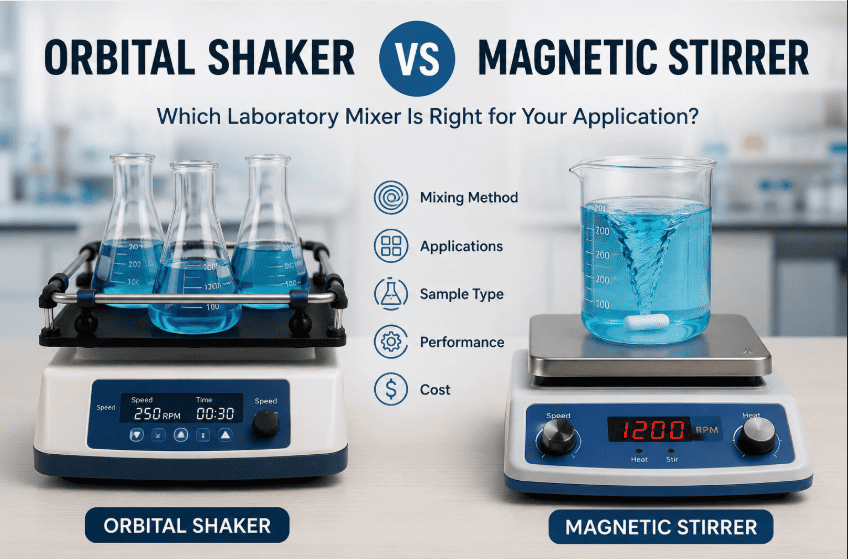
When comparing an orbital shaker vs magnetic stirrer, the main difference lies in how each device mixes laboratory samples. Orbital shakers use circular motion to provide gentle, uniform agitation for applications such as cell culture, microbiology, and flask mixing, while magnetic stirrers use a rotating stir bar to rapidly mix liquids and dissolve chemicals inside containers. Although both are common types of laboratory mixing equipment, they are designed for different workflows, sample types, and research applications.
Choosing between a laboratory shaker and a magnetic stirrer depends on factors such as sample volume, aeration requirements, mixing speed, heating capability, and the type of experiment being performed. In this guide, we compare their working principles, applications, advantages, and limitations to help you decide which laboratory mixing device is best for your needs.
For laboratories focused on microbiology, cell culture, or routine sample agitation, choosing the right mixing device often starts with understanding the role of orbital shakers for laboratory applications and magnetic stirrers for chemical mixing and solution preparation.
Orbital Shaker vs Magnetic Stirrer: Key Differences
Although orbital shakers and magnetic stirrers are both used for laboratory sample mixing, they are designed for very different applications. An orbital shaker moves containers using continuous circular motion, making it ideal for cell culture, microbiology, and gentle sample agitation. In contrast, a magnetic stirrer uses a rotating magnetic stir bar inside a container to rapidly mix liquids and dissolve chemicals. The best choice depends on factors such as sample type, aeration requirements, mixing speed, heating capability, and laboratory workflow.
| Feature | Orbital Shaker | Magnetic Stirrer |
|---|---|---|
| Mixing Method | Orbital circular motion | Rotating magnetic stir bar |
| Best For | Cell culture, microbiology, flask mixing | Chemical mixing, dissolving reagents |
| Sample Capacity | Multiple flasks or containers | Usually one container at a time |
| Aeration | Excellent oxygen transfer | Limited aeration |
| Heating Capability | Usually not included | Often available with hotplate |
| Mixing Style | Gentle and uniform agitation | Fast and direct stirring |
| Suitable for Biological Samples | Yes | Limited in some applications |
| Ideal Sample Volume | Medium to large volumes | Small to medium volumes |
| Common Lab Use | Bacterial culture, incubation | Chemistry and solution preparation |
| Maintenance | Minimal | Requires stir bars and cleaning |
In general, orbital shakers are preferred for biological and cell culture applications that require gentle agitation and proper aeration, while magnetic stirrers are better suited for fast liquid mixing, chemical dissolution, and laboratory heating applications.
When to Use an Orbital Shaker
An orbital shaker is the preferred choice for laboratory applications that require gentle, continuous, and uniform sample agitation. Unlike magnetic stirrers, orbital shakers move containers in a circular motion, making them ideal for cell culture, microbiology, bacterial incubation, and flask mixing applications where proper aeration and oxygen transfer are important. Because orbital shakers can handle multiple flasks or containers simultaneously, they are commonly used in research laboratories, biotechnology labs, pharmaceutical facilities, and academic environments.
Orbital shakers are especially useful for suspension cultures, microbial growth studies, protein expression workflows, staining procedures, and applications that require consistent mixing without direct contact between the mixing mechanism and the sample. In microbiology and cell culture laboratories, orbital motion helps maintain homogeneous conditions while minimizing shear stress that could damage sensitive biological samples.
You should use an orbital shaker when:
- Working with cell cultures or bacterial cultures
- Mixing multiple flasks at the same time
- Gentle and uniform agitation is required
- Proper aeration and oxygen transfer are important
- Handling medium to large sample volumes
- Performing long-duration incubation and shaking applications
Because of their versatility and ability to support biological workflows, orbital shakers are widely considered one of the most important pieces of laboratory mixing equipment for microbiology, biotechnology, and life science research applications.
Many research laboratories prefer orbital shakers for microbiology and cell culture applications because they provide gentle agitation and improved oxygen transfer for sensitive biological samples.
When to Use a Magnetic Stirrer
A magnetic stirrer is best suited for laboratory applications that require fast, efficient, and continuous liquid mixing. Unlike orbital shakers, magnetic stirrers use a rotating magnetic stir bar inside the container, making them highly effective for dissolving chemicals, preparing reagents, mixing low-viscosity solutions, and maintaining homogeneous samples during laboratory procedures. Because many models also include a built-in hotplate, magnetic stirrers are widely used in chemistry laboratories, analytical labs, educational settings, and research environments where simultaneous heating and stirring are required.
Magnetic stirrers are particularly useful for chemical dissolution, buffer preparation, titration workflows, pH adjustment, and routine sample preparation tasks. Their compact design, precise speed control, and ability to rapidly mix liquids make them one of the most commonly used pieces of laboratory mixing equipment for daily benchwork applications.
You should use a magnetic stirrer when:
- Dissolving powders or chemical reagents
- Preparing laboratory buffers and solutions
- Heating and stirring samples simultaneously
- Working with small to medium liquid volumes
- Performing routine chemistry laboratory procedures
- Rapid and direct liquid mixing is required
Although magnetic stirrers are extremely efficient for chemical and analytical applications, they are generally less suitable for biological workflows that require gentle agitation, large flask handling, or enhanced aeration. For this reason, many laboratories use both orbital shakers and magnetic stirrers together depending on the experiment and sample type.
For routine chemistry workflows and reagent preparation, many laboratories rely on magnetic stirrers for laboratory solution mixing because of their compact design and rapid mixing performance.
Pros and Cons of Orbital Shaker vs Magnetic Stirrer
Both orbital shakers and magnetic stirrers are essential types of laboratory mixing equipment, but each device offers different advantages depending on the application, sample type, and laboratory workflow. Understanding the strengths and limitations of each system can help researchers choose the most effective mixing solution for microbiology, chemistry, biotechnology, and routine laboratory applications.
Orbital Shaker Pros & Cons
Orbital shakers are widely used in microbiology, biotechnology, and life science laboratories because they provide gentle and uniform agitation while supporting proper aeration and oxygen transfer. Their ability to mix multiple flasks simultaneously makes them highly effective for bacterial culture growth, suspension cell culture, and long-duration incubation workflows.
Pros of Orbital Shakers
- Excellent for cell culture and microbiology applications
- Provides gentle and uniform sample agitation
- Supports proper aeration and oxygen transfer
- Can handle multiple flasks or containers simultaneously
- Ideal for long-duration incubation and shaking applications
- Reduces direct mechanical stress on sensitive biological samples
Cons of Orbital Shakers
- Usually larger and more expensive than magnetic stirrers
- Most models do not include heating capability
- Less effective for dissolving powders or chemical reagents quickly
- Requires more bench space in laboratory environments
- Not ideal for highly viscous liquid mixing applications
Magnetic Stirrer Pros & Cons
Magnetic stirrers are commonly used in chemistry and analytical laboratories because they provide rapid, direct, and efficient liquid mixing. Their compact size, simple operation, and optional hotplate functionality make them ideal for routine sample preparation, chemical dissolution, and buffer preparation workflows.
Pros of Magnetic Stirrers
- Fast and efficient liquid mixing
- Excellent for dissolving chemicals and reagents
- Compact and space-saving laboratory equipment
- Many models include built-in heating capability
- Easy to operate and maintain
- Suitable for routine laboratory and educational applications
Cons of Magnetic Stirrers
- Limited aeration compared to orbital shakers
- Typically designed for one container at a time
- Less suitable for cell culture and biological workflows
- Magnetic stir bars may cause sample contamination in some applications
- Not ideal for large-volume flask mixing or suspension cultures
In many modern laboratories, orbital shakers and magnetic stirrers are used together because each device is optimized for different types of sample mixing and laboratory applications.
Laboratories working with highly viscous liquids may also consider using overhead stirrers for high-viscosity mixing applications when magnetic stirrers are no longer effective.
How to Choose Between an Orbital Shaker and a Magnetic Stirrer
Choosing between an orbital shaker and a magnetic stirrer depends largely on your laboratory application, sample type, and mixing requirements. Although both devices are used for liquid mixing and sample agitation, they are designed for different workflows and research environments. Selecting the right laboratory mixing equipment can improve experimental consistency, sample quality, and overall laboratory efficiency.
Consider Your Laboratory Application
The first factor to consider is the type of laboratory work being performed. Orbital shakers are commonly used in microbiology, biotechnology, molecular biology, and cell culture laboratories where gentle agitation and proper aeration are essential. In contrast, magnetic stirrers are more suitable for chemistry labs, analytical laboratories, and routine sample preparation workflows that require rapid liquid mixing and chemical dissolution.
Evaluate Sample Volume and Container Type
Orbital shakers are generally better for handling multiple flasks, bottles, or culture containers at the same time, especially for medium to large sample volumes. Magnetic stirrers are typically more effective for small to medium liquid volumes inside beakers, flasks, or laboratory glassware where direct stirring is needed.
Determine Whether Aeration Is Important
For biological applications such as bacterial culture growth or suspension cell culture, aeration and oxygen transfer are critical. Orbital shakers provide continuous orbital motion that helps maintain homogeneous conditions while improving oxygen distribution throughout the sample. Magnetic stirrers provide limited aeration and are usually less effective for these types of biological workflows.
Consider Heating Requirements
If your laboratory procedures require simultaneous heating and stirring, a magnetic stirrer with a built-in hotplate may be the better option. These systems are widely used for dissolving powders, preparing buffers, and heating chemical solutions during laboratory experiments. Most standard orbital shakers do not include integrated heating functionality unless they are part of an incubator shaker system.
Think About Long-Term Laboratory Workflow
Laboratories that frequently perform microbiology, biotechnology, or incubation-based workflows often benefit more from orbital shakers because they support continuous shaking over long periods while handling multiple samples efficiently. On the other hand, laboratories focused on chemistry, reagent preparation, and routine benchwork may find magnetic stirrers more practical because of their compact size, simplicity, and rapid mixing performance.
In many research environments, orbital shakers and magnetic stirrers complement each other rather than replace one another. The best choice ultimately depends on the specific laboratory application, sample characteristics, and experimental goals.
In temperature-sensitive workflows, some laboratories combine shaking and mixing systems with laboratory water baths for controlled heating applications.
Frequently Asked Questions About Orbital Shakers and Magnetic Stirrers
The main difference between an orbital shaker and a magnetic stirrer is the mixing method. Orbital shakers use circular orbital motion to gently agitate samples, while magnetic stirrers use a rotating magnetic stir bar to directly mix liquids inside a container. Orbital shakers are commonly used for biological applications, whereas magnetic stirrers are more suitable for chemical mixing and solution preparation.
Orbital shakers are generally better for cell culture applications because they provide gentle and uniform agitation while improving aeration and oxygen transfer. This helps maintain healthy growth conditions for bacterial cultures and suspension cells without exposing samples to excessive mechanical stress.
A magnetic stirrer can replace an orbital shaker in some basic liquid mixing applications, but it is usually not ideal for microbiology or cell culture workflows. Orbital shakers are specifically designed for gentle agitation, aeration, and handling multiple flasks simultaneously, making them more suitable for biological research applications.
Most standard orbital shakers do not include heating capability. However, incubator shakers combine orbital shaking with temperature control for applications such as bacterial incubation and cell culture growth. Magnetic stirrers with hotplates are generally more common for simultaneous heating and stirring.
Magnetic stirrers are mainly used for dissolving chemicals, preparing laboratory buffers, mixing reagents, and maintaining homogeneous liquid solutions. They are widely used in chemistry, analytical laboratories, educational labs, and routine sample preparation workflows.
Yes, orbital shakers are often preferred in microbiology laboratories because they provide consistent agitation and better oxygen transfer for bacterial growth and suspension cultures. Their ability to mix multiple flasks at the same time also makes them highly practical for laboratory incubation workflows.
Magnetic stirrers are usually better for chemical dissolution because they provide fast and direct liquid mixing. Many models also include a built-in hotplate, allowing simultaneous heating and stirring during laboratory procedures.
Yes, orbital shakers generally provide better aeration than magnetic stirrers. Their continuous orbital motion improves oxygen distribution throughout the sample, making them especially useful for microbiology, biotechnology, and cell culture applications.
Final Verdict: Orbital Shaker or Magnetic Stirrer?
When comparing an orbital shaker vs magnetic stirrer, there is no single “best” option for every laboratory application. Both devices are essential types of laboratory mixing equipment, but they are designed for different workflows, sample types, and research requirements. The right choice ultimately depends on how the samples need to be mixed, whether aeration or heating is required, and the type of experiments being performed.
Orbital shakers are generally the better choice for microbiology, biotechnology, molecular biology, and cell culture applications where gentle agitation, uniform mixing, and proper oxygen transfer are important. Their ability to handle multiple flasks simultaneously makes them highly effective for bacterial culture growth, suspension cultures, and long-duration incubation workflows.
On the other hand, magnetic stirrers are more suitable for chemistry laboratories, analytical workflows, and routine sample preparation tasks that require rapid liquid mixing or chemical dissolution. Their compact size, ease of use, and optional hotplate functionality make them one of the most practical laboratory tools for daily benchwork applications.
For laboratories focused on biological research and culture-based experiments, an orbital shaker is often the better long-term investment. However, for chemical mixing, reagent preparation, and heating applications, magnetic stirrers remain one of the most efficient and cost-effective solutions available.
In many modern research laboratories, orbital shakers and magnetic stirrers are used together because each device serves a different but equally important role in laboratory sample preparation and liquid mixing workflows.