
1. introduction
In the world of physics, precisely measuring resistance, inductance, and capacitance is absolutely vital. Even the tiniest error in these measurements can greatly impact your experiment’s outcome. I’ve seen many researchers and lab technicians struggle with imprecise tools that lead to inaccurate outcomes. I know how frustrating that can be from my own experience working with different LCR meters in lab settings. This is precisely why choosing top precision LCR meters for physics experiments is so important for researchers.
Accurate and reliable lab tools are not just nice to have; they’re necessary when precision makes all the difference in physics experiments. Especially in studies involving AC circuits or electromagnetism, getting the measurements right can be a game-changer.
In this article, I’ll introduce 4 of the top precision LCR meters for physics experiments in 2025 — models that researchers trust for their accuracy and performance. Some of these I’ve tested myself, and they proved to deliver reliable results under real lab conditions. If you want to pick the best tool for your physics work, stay with me until the end.
If you’re building a complete physics lab setup, you may also want to check out our guide to the best DC power supplies for students and labs — accuracy and stability matter just as much as in LCR meters.
2. Why You Need a Precision LCR Meter for Physics Labs
LCR stands for three key electrical properties: inductance, capacitance, and resistance. Inductance is all about the magnetic energy stored inside a coil, and it’s measured in henries (H). Capacitance refers to how much electrical energy a capacitor can hold in an electric field, measured in farads (F). Resistance tells us how much a circuit resists the flow of electric current, and it’s measured in ohms (Ω).
If you’re working in physics or electronics, these three values are the foundation of so many experiments. Even a tiny mistake in measuring them can lead to results that just don’t add up. That’s why having a precision LCR meter is so critical — it ensures your measurements are both accurate and reliable.
This is especially true in physics experiments dealing with AC circuits and electromagnetism, where precision matters a lot. Unlike a regular multimeter that only measures DC resistance, a precision LCR meter can test components at different frequencies. This gives you much more detailed and trustworthy data, which is exactly what you need for serious lab work or research.
Alongside an LCR meter, having a top digital multimeter for physics experiments helps you handle both AC and DC measurements with confidence.
3. Key Features to Look for in a Precision LCR Meter
If you’re looking to buy a precision LCR meter for your lab work, the first thing you should pay attention to is accuracy. Whether you’re measuring resistance, inductance, or capacitance, even the smallest error can throw off your entire experiment. That’s why a good LCR meter needs to deliver measurements with extremely low error—ideally around ±0.1%—so you can trust your results and avoid redoing your tests.
Another key factor is the test frequency range. Component behavior often changes depending on the frequency, so your meter should be able to assess values accurately across different frequencies. For most physics experiments, especially those dealing with AC circuits or electromagnetic properties, a frequency range that goes up to 100 kHz is highly recommended.
What sets advanced LCR meters apart is their ability to provide more than just the basics. In addition to L, C, and R, they often offer values like the Q-factor, equivalent series resistance (ESR), and phase angle, helping you gain a deeper understanding of the components you’re working with. These extra details can be crucial when you’re doing sensitive lab experiments or detailed research.
In the next section, I’ll walk you through the top 4 precision LCR meters of 2025—explaining what makes each one special and how they can help you get more accurate results in the lab.
For signal testing and waveform analysis, consider adding a digital oscilloscope to your lab setup — it’s a perfect companion to an LCR meter.
4. Top 4 Precision LCR Meters for Physics Experiments in 2025
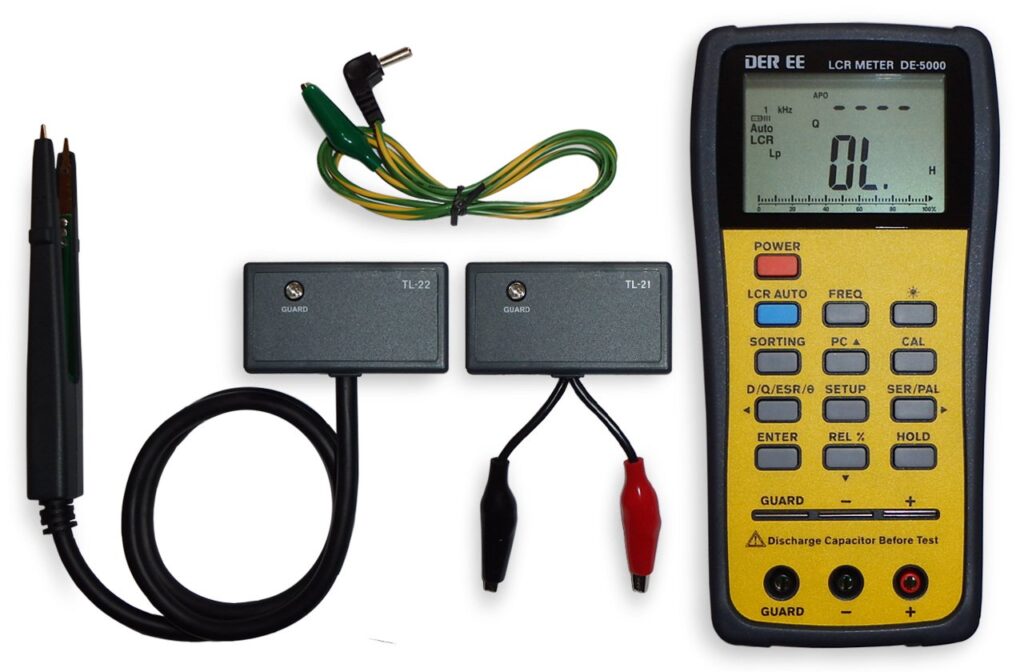
4.1. DER EE DE-5000 Handheld LCR Meter – Best for High Accuracy
The DER EE DE-5000 is one of the most accurate handheld LCR meters I’ve ever used in a lab setting. During multiple experiments, it consistently delivered reliable results — and it’s surprisingly easy to use, even for beginners.
What stands out right away is the dual display (19999/9999 counts), which gives you highly detailed readings of inductance, capacitance, and resistance. On top of that, it also measures secondary parameters like dissipation factor (D), quality factor (Q), phase angle, and equivalent series/parallel resistance (ESR/Rp) — giving you a complete picture of your component’s performance.
Another feature I love is the AUTO-LCR mode. This smart function automatically detects whether you’re testing L, C, or R — no need to manually change settings. It also supports a wide range of test frequencies (100 Hz, 120 Hz, 1 kHz, 10 kHz, and up to 100 kHz), making it perfect for both physics and electronics experiments where component behavior varies by frequency.
Key Features:
- High Accuracy: Measures L, C, and R with minimal error for trustworthy lab results
- Auto-Ranging Mode: Saves time by automatically selecting the correct measurement function
- Wide Frequency Range: Supports up to 100 kHz for detailed component testing
- Portable Design: Lightweight and easy to carry around the lab
- Full Kit Included: Comes with test leads, SMD tweezers, guard line, and a carrying case
Pros:
- Very easy to use, even for students
- Delivers consistent, high-precision readings
- Covers a wide range of frequencies for advanced testing
- Handy and portable — great for fieldwork or classroom labs
Cons:
- No built-in USB interface unless added separately
- May need occasional calibration for maximum accuracy
Ideal For:
If you’re a researcher, student, or lab technician looking for a precise and versatile LCR meter, the DE-5000 is a solid choice. It’s especially useful for physics experiments where accuracy matters.
Check Price and Details on Amazon
4.2. Extech LCR200 Passive Component LCR Meter – Reliable & Compact
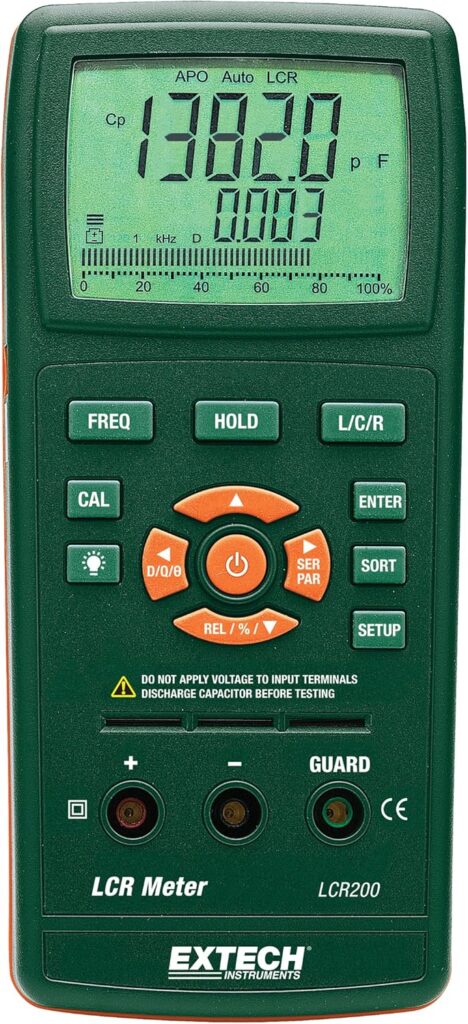
The Extech LCR200 is another precise and compact LCR meter I’ve worked with in real lab conditions — and honestly, it impressed me with its accuracy and straightforward design. For a handheld device, it packs a lot of essential features that make it perfect for day-to-day lab testing.
Just like its name suggests, it accurately measures inductance, capacitance, and resistance. But it doesn’t stop there — it also provides secondary parameters like Q (Quality factor), D (Dissipation), Phase (P), and ESR (Equivalent Series Resistance). These additional values are extremely helpful when you need a deeper understanding of your components.
One feature I really appreciate is the ability to set Hi/Lo limits — either by absolute values or percentages — which makes quick evaluation of component quality much easier. The five available test frequencies also give you flexibility depending on the part you’re analyzing. You can even switch between parallel or series equivalent circuit modes, depending on your testing needs.
Key Features:
- Accurately Measures L, C, and R values
- Advanced Parameters: Q, D, Phase, ESR
- Five Test Frequencies: Tailored testing for different components
- Hi/Lo Limits: Define thresholds based on value or %
- Selectable Circuit Mode: Choose between parallel or series model
- Lightweight Design: Weighs only 0.43 kg — easy to carry and use
Pros:
- Excellent accuracy for a compact device
- User-friendly and ideal for lab or classroom settings
- Lets you monitor secondary electrical characteristics easily
- Great value for routine component testing
Cons:
- Doesn’t have as many frequency options as higher-end models
- Not ideal for automated or high-throughput testing
Ideal For:
If you’re looking for a lightweight, battery-powered LCR meter that still offers precise measurements and extra diagnostic features, the Extech LCR200 is a great fit — whether you’re a student, technician, or researcher in the lab.
👉 Check Price and Details on Amazon
4.3. B&K Precision 880 Handheld LCR Meter – High-End Precision for Serious Lab Work
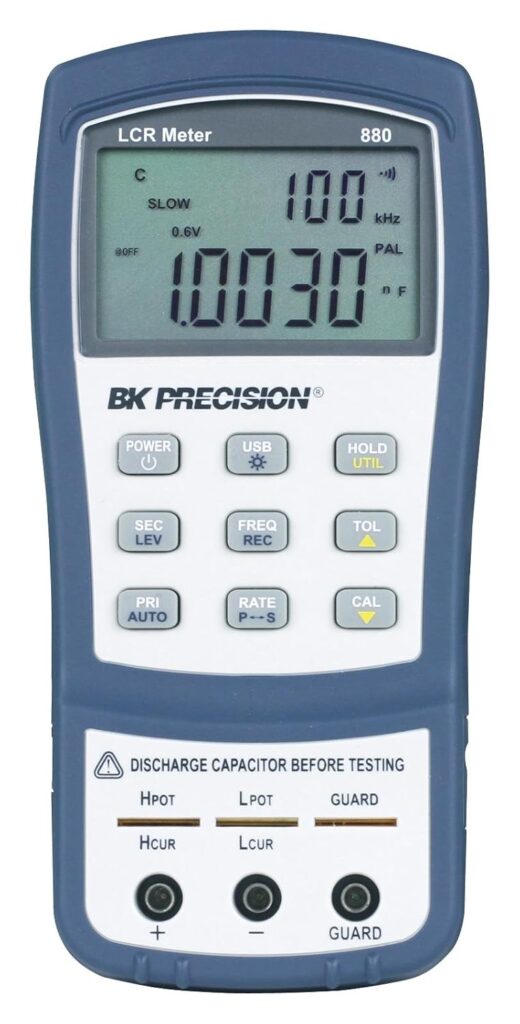
Out of all the LCR meters I’ve tested, the B&K Precision 880 stands out as one of the most advanced and reliable. If you’re looking for professional-level accuracy and functionality for physics or electronics lab experiments, this handheld device won’t disappoint.
What makes the 880 truly special is its dual high-resolution display—offering up to 40,000 counts on the primary and 10,000 counts on the secondary screen. It handles all essential measurements including inductance (L), capacitance (C), resistance (R), and impedance (Z) (available on models 879B and 880).
It also automatically calculates important secondary parameters such as Dissipation Factor (D), Quality Factor (Q), Phase Angle (Theta), Equivalent Series Resistance (ESR), and DC Resistance (DCR) (only on the 880 model). With accuracy up to ±0.1% and support for test frequencies up to 100 kHz, it’s perfect for complex analysis in research settings.
Key Features:
- High-resolution dual display: 40,000 counts (primary) and 10,000 counts (secondary)
- Measures L, C, R, and Z with exceptional accuracy
- Automatic calculation of D, Q, Theta, ESR, and DCR
- Selectable test frequencies up to 100 kHz
- Fast auto-ranging for quick and easy measurements
Pros:
- Excellent accuracy and detailed measurement capability
- Supports a wide range of test frequencies
- Ideal for both advanced research and professional lab environments
Cons:
- Slightly heavier than compact handheld models
- Higher price point compared to basic LCR meters
Best For:
Engineers, researchers, and university students working on advanced electronics or physics experiments who require highly accurate, versatile measurements in the lab.
👉 Check Price and Details on Amazon
4.4. East Tester ET430 Handheld LCR Meter – Best for Budget-Conscious Precision
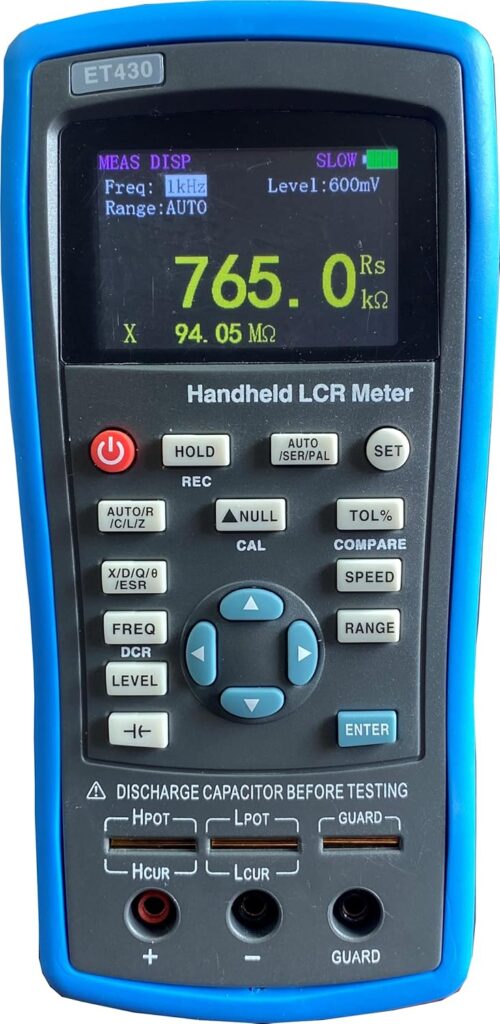
If you’re looking for a budget-friendly option without compromising too much on performance, the ET430 by East Tester is worth considering. With a 5-digit display and accuracy up to 0.3%, this handheld device is designed to deliver decent precision for everyday lab work and component testing.
The ET430 supports measurement of inductance, capacitance, and resistance, making it a solid tool for basic physics or electronics experiments. While it may not offer the same advanced features as some premium models, it still holds its ground with good resolution and user-friendly operation.
Although I haven’t personally tested this model in a lab environment, user reviews suggest that it performs reliably for standard component analysis.
Key Features
- 3-in-1 Functionality: Accurately measures inductance (L), capacitance (C), and resistance (R) — essential parameters for electronics and physics experiments.
- 0.3% Accuracy: Provides respectable precision, making it suitable for educational labs and basic research setups.
- 5-Digit Display: Large and clear digital display ensures easy reading of values, even for small components.
- Handheld & Battery Powered: Compact and portable design lets you carry it around easily — ideal for on-the-go measurements or classroom demonstrations.
- User-Friendly Operation: Simple interface with minimal setup required, perfect for students or anyone new to using LCR meters.
Pros:
- Decent Accuracy: Offers up to 0.3% precision, which is respectable for its price range.
- 5-Digit Display: Clear and detailed readout for more precise component readings.
- Measures L, C, and R: Covers all essential parameters for physics and electronics projects.
- Battery Powered: Portable and easy to use in different lab or field settings.
- Budget-Friendly: One of the more affordable precision LCR meters available.
Cons:
- No USB or Data Logging: Lacks advanced connectivity options for exporting results.
- Limited Advanced Features: Doesn’t offer Q-factor, ESR, or phase angle measurements.
- Not Lab-Tested Personally: I haven’t used this model directly in the lab, so hands-on performance is based on available specs and user reviews.
Best For:
Students, hobbyists, and budget-conscious researchers looking for a reliable, no-frills LCR meter that gets the job done for basic inductance, capacitance, and resistance measurements.
👉 Check Price and Details on Amazon
5. Comparison Table: Top 4 Precision LCR Meters for Physics Labs in 2025
Before you decide which LCR meter to buy, it helps to see how the top models stack up against each other in terms of features, accuracy, and ease of use. The table below gives you a side-by-side comparison of the 4 best precision LCR meters for physics experiments in 2025. Whether you’re a student doing lab work or a researcher working on sensitive measurements, this quick overview will help you find the model that best fits your needs.
| Feature | DER EE DE-5000 | Extech LCR200 | B&K Precision 880 | East Tester ET430 |
|---|---|---|---|---|
| Accuracy | ±0.25% (typical), up to ±0.1% | ±0.3% | Up to ±0.1% | ±0.3% |
| Test Frequency Range | 100 Hz to 100 kHz | 100 Hz to 10 kHz | 100 Hz to 100 kHz | Not specified |
| Display | Dual, 19999/9999 counts | Single, 19999 count | Dual, 40,000 / 10,000 counts | 5-digit LCD display |
| Secondary Parameters | Q, D, ESR, Phase angle | Q, D, ESR, Phase | Q, D, Theta, ESR, DCR | Not specified |
| Auto-Ranging | Yes (AUTO-LCR) | Yes | Yes | Not clear |
| Portability | Lightweight, handheld | Lightweight | Heavier but handheld | Handheld |
| Best For | Lab-grade precision & versatility | Quick checks & basic experiments | High-end labs needing precision | Students & budget-conscious users |
| USB/Data Output | No (optional cable available) | No | Yes (via interface) | Not specified |
6. Conclusion: Which LCR Meter Should You Choose?
Choosing the right LCR meter depends on your specific needs, lab conditions, and the level of accuracy required in your experiments. Here’s a quick recap to help you decide:
- Best Overall Performance: The B&K Precision 880 stands out for its high accuracy (up to ±0.1%) and advanced measurement capabilities like DCR and Z, making it perfect for professional research labs.
- Most Accurate Budget Option: The DER EE DE-5000 offers impressive precision, a wide frequency range, and great portability—ideal for students and researchers who want reliability without breaking the bank.
- Compact & Reliable: The Extech LCR200 is a solid choice for labs that prioritize simplicity, portability, and solid secondary measurement parameters.
- Entry-Level with Great Value: The East Tester ET430 is suitable for those starting out or working on less complex experiments, offering reliable results at a lower price point.
No matter which model you choose, investing in a quality LCR meter can significantly improve your measurement accuracy and research outcomes.
Planning your equipment on a budget? Our list of the best budget laptops for students in 2025 includes affordable options great for lab work, data analysis, and report writing.
Ready to Choose the Best LCR Meter?
Click below to learn more about each product and find the perfect fit for your experiments:
🟢 DER EE DE-5000 – View on Amazon
🟡 B&K Precision 880 – See Product
Frequently Asked Questions (FAQ)
Q1: What’s the difference between an LCR meter and a multimeter?
A: A multimeter typically measures only DC resistance, voltage, and current. An LCR meter can measure inductance (L), capacitance (C), and resistance (R) at various AC frequencies, providing more precise and detailed data—especially critical in physics labs.
Q2: Do I really need test frequencies up to 100 kHz?
A: If you’re dealing with components whose behavior changes at different frequencies—like in AC circuit or RF applications—yes. Higher test frequencies improve accuracy in those cases.
Q3: Is a handheld LCR meter as accurate as a benchtop one?
A: While benchtop models may offer more stability and advanced features, many modern handheld meters (like the DE-5000 or B&K 880) provide lab-grade accuracy suitable for most academic and research purposes.
Q4: What secondary parameters should I care about?
A: Key ones include Q-factor (quality), D (dissipation), ESR (equivalent series resistance), and phase angle. These help you understand how components perform under real-world conditions.
Q5: Can I use a cheap LCR meter for serious experiments?
A: You can, but be cautious. Entry-level models may lack frequency range or accuracy. For sensitive physics work, invest in a trusted, precise meter to avoid misleading results.