
1. Introduction
When it comes to university labs, the right equipment isn’t just a nice-to-have—it’s the foundation of meaningful learning and accurate research. Among the essential tools, spectrum analyzers play a key role in helping students and researchers analyze frequency-domain signals, particularly in physics, electronics, and RF experiments.
I still remember the first time I used a spectrum analyzer during a telecommunications lab. Honestly, I had no idea what I was looking at on the screen. But that early experience taught me something valuable: having the right device—one with good resolution, intuitive controls, and student-friendly features—can make all the difference in how quickly and deeply you learn.
In this guide, we’ll explore some of the best spectrum analyzers for university labs in 2025—ranging from high-end benchtop models used in advanced physics departments to affordable, portable units perfect for students just starting out. Whether you’re equipping a lab or looking for a personal learning tool, you’ll find expert recommendations to match your needs and budget.
2. What Is a Spectrum Analyzer and Why Is It Used in University Labs?
A spectrum analyzer is a test instrument that displays signal amplitude as it varies by frequency. Unlike digital oscilloscopes, which show how signals change over time, spectrum analyzers reveal how those signals are distributed across the frequency domain. This makes them essential for identifying, measuring, and analyzing the frequency components of electrical signals.
In university labs—particularly those focused on physics, electronics, and RF communications—spectrum analyzers are widely used for both teaching and research purposes. They help students:
- Visualize and understand signal spectra
- Identify sources of noise or interference
- Analyze frequency response in circuits
- Measure bandwidth and signal strength
- Perform RF and microwave experiments
- Learn the practical side of modulation, filtering, and communication systems
Modern spectrum analyzers come in various forms, including benchtop units, portable models, and USB-powered devices. In academic settings, the choice often depends on the lab’s focus area (e.g., analog electronics vs. wireless systems) and the available budget.
Whether it’s an entry-level engineering course or an advanced research project, a well-chosen spectrum analyzer gives students hands-on experience with real-world signal analysis—something textbooks alone can’t offer.e can’t offer.
3. Key Factors to Consider Before Buying a Spectrum Analyzer
Choosing the right spectrum analyzer for your university lab isn’t just about picking the most expensive model. It’s about finding a device that fits your educational goals, technical needs, and budget. Whether you’re an instructor setting up a lab or a student investing in your first analyzer, here are the key features to look for:
3.1. Frequency Range
The frequency range tells you what kind of signals the analyzer can measure. For most electronics experiments or RF lab work, an analyzer with a range up to 1.5 GHz is usually enough. However, advanced physics or wireless research may require models that go beyond 2 GHz.
Tip: If your lab also works with passive components or impedance testing, pairing a spectrum analyzer with a reliable LCR meter can give you a complete picture of your circuit’s behavior.
3.2. Resolution Bandwidth (RBW)
RBW determines how well the analyzer can distinguish between two closely spaced signals. The narrower the RBW, the better the frequency resolution. For university-level projects, a minimum RBW of 10 kHz is often sufficient, but higher-end models offer much finer resolution.
3.3. Portability and Form Factor
Do you need a benchtop spectrum analyzer for a fixed lab, or a portable or USB-based analyzer you can carry to different classrooms? If flexibility matters, look for compact models like the TinySA or USB analyzers that connect directly to a laptop.
3.4. PC Connectivity and Software
Modern labs rely heavily on software-based analysis. Many analyzers offer USB or LAN connectivity and come with dedicated software for advanced visualization, signal recording, and FFT display. These features are especially useful for data-driven courses or research projects.
3.5. Ease of Use and Interface
Let’s face it: not every student is an RF engineer. A good spectrum analyzer for educational labs should have a clear display, an intuitive menu, and shortcut buttons for commonly used functions. This reduces the learning curve and keeps students focused on the experiments—not the manual.
3.6. Budget and Value
You don’t need to break the bank to get a decent device. In fact, many affordable lab tools like DC power supplies offer excellent performance at student-friendly prices. Spectrum analyzers are no exception. Look for reliable brands that balance cost and functionality, especially if you’re purchasing multiple units for a teaching lab.
Final Thought
The best spectrum analyzer is the one that meets your lab’s needs—not necessarily the one with the most features. Think about what you’ll actually use it for, and choose a model that offers the right mix of performance, ease of use, and cost.
4. Top 4 Spectrum Analyzers for University Labs (2025 Picks)
Choosing the right spectrum analyzer for a university lab can feel overwhelming—especially with so many models on the market. To help you cut through the noise, we’ve selected 4 top-rated spectrum analyzers that strike the right balance between functionality, usability, and price.
Whether you’re equipping an advanced RF lab or looking for a student-friendly portable model, these picks are lab-tested, budget-aware, and education-ready.
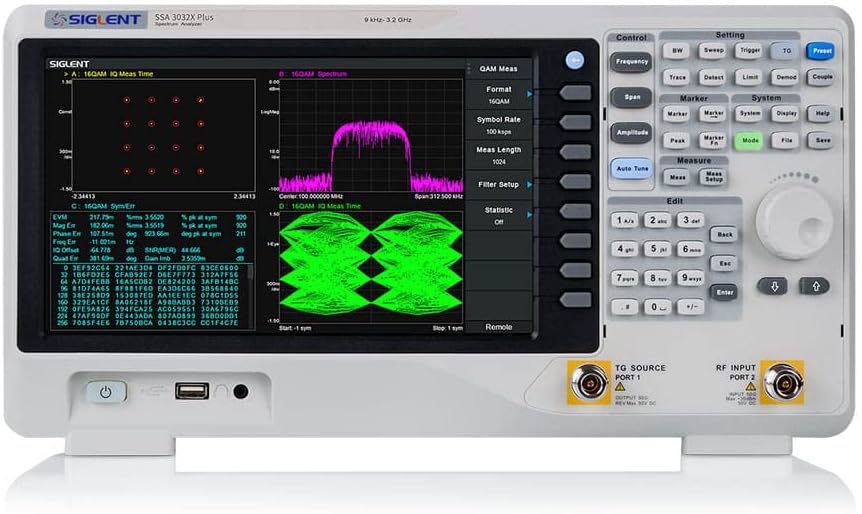
4.1. Siglent SSA3021X Plus – Best for Advanced University Labs
If your lab handles serious RF work, the Siglent SSA3021X Plus is a rock-solid choice. With a frequency range up to 2.1 GHz, built-in tracking generator, and preamp, this analyzer is designed for advanced testing, research, and teaching in physics and electronics departments.
Key Advantages:
- Wide frequency coverage up to 2.1 GHz
- Built-in tracking generator – ideal for filter and component testing
- Preamplifier included for improved low-signal sensitivity
- Exceptionally low DANL: −161 dBm/Hz
- Intuitive interface and sharp display – good for student use
Drawbacks:
- Pricey (~$1,733), not ideal for budget-limited setups
- Slightly bulky for small lab benches or shared spaces
Bottom Line:
This is a lab-grade spectrum analyzer built for serious signal analysis and instruction. If your department supports RF or communication courses, this tool delivers professional-level results with minimal compromise.
🔗This model typically costs about $1,733, but prices may vary. See on Amazon.
4.2. Rigol DSA815-TG – Best Value for Teaching Labs
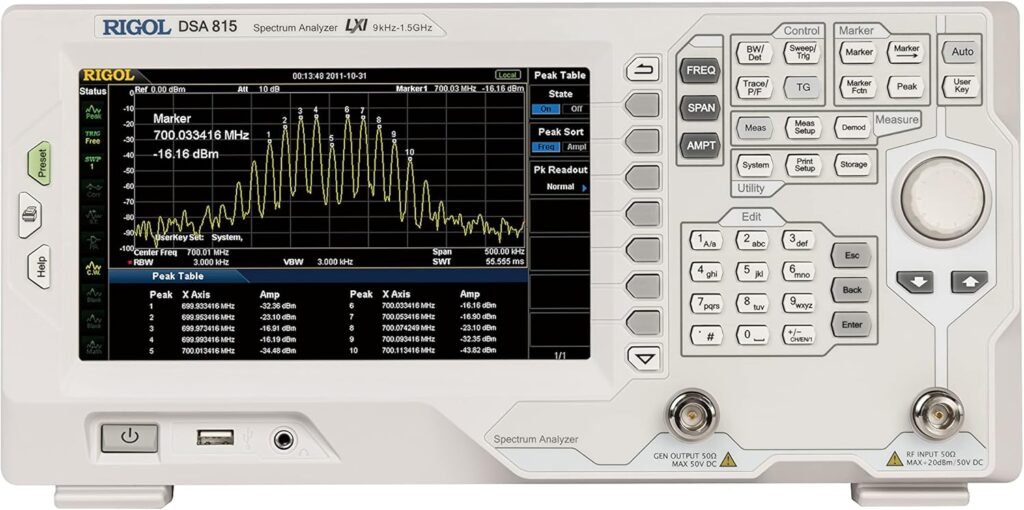
If you’re setting up a university electronics lab and want the best bang for your buck, the Rigol DSA815-TG is a proven and popular choice. With a frequency range of 9 kHz to 1.5 GHz, integrated tracking generator, and excellent signal analysis tools, this model has been a go-to analyzer for academic and R&D labs worldwide since its release.
Key Advantages:
- Covers essential lab needs: 9 kHz to 1.5 GHz
- Built-in 1.5 GHz tracking generator for component and filter testing
- Comes with a preamplifier to improve sensitivity on low-level signals
- Includes multiple markers and peak table function for faster peak signal detection
- Excellent value under $1,000 – great for multi-unit lab setups
Drawbacks:
- Slightly older hardware (first released ~2012), though still reliable
- Basic display compared to newer models
Bottom Line:
The DSA815-TG remains one of the most widely used spectrum analyzers in teaching labs for good reason. It strikes a near-perfect balance of price, features, and performance—making it ideal for university electronics courses, RF basics, and lab demonstrations.
🔗This model typically costs about $999.00, but prices may vary. See on Amazon.
4.3. SeeSii TinySA Ultra – Best Handheld Option for Students and Mobile Labs
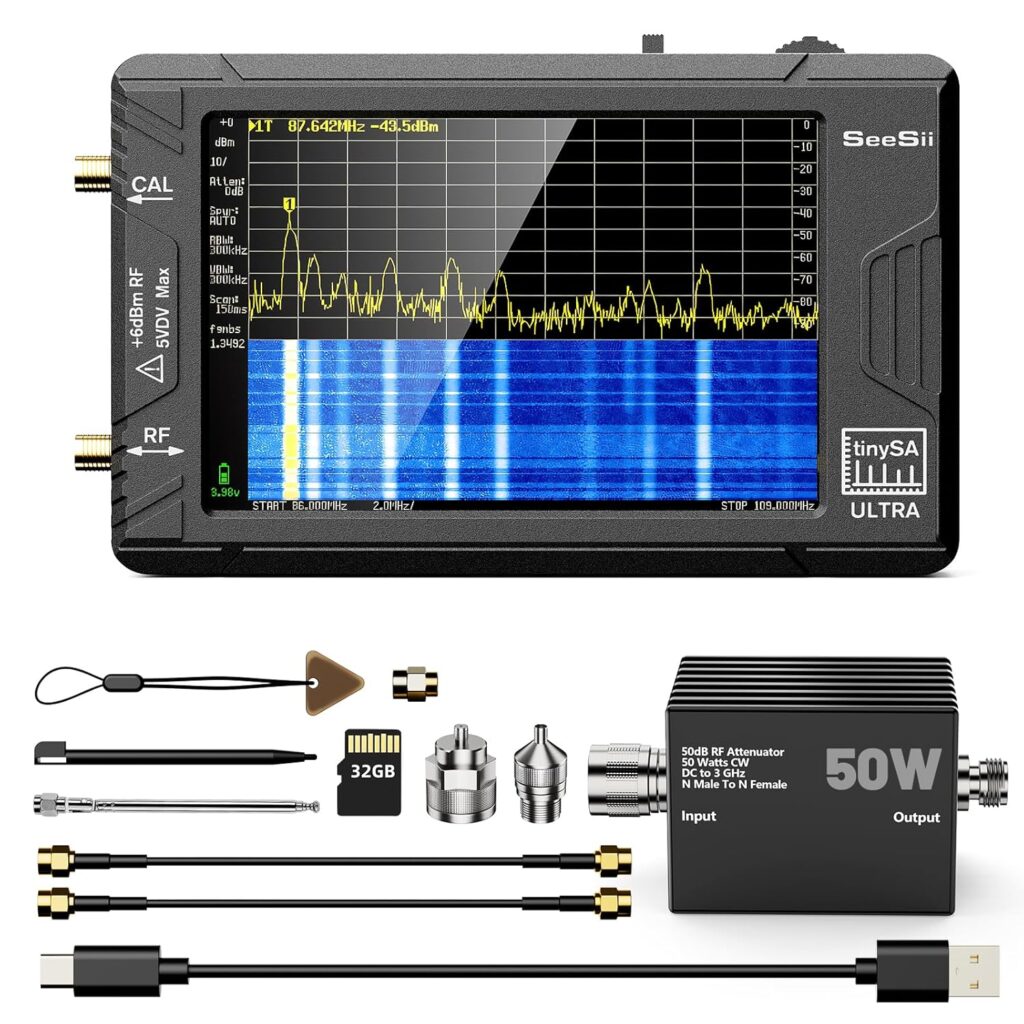
For students or instructors who need a compact and affordable spectrum analyzer, the SeeSii TinySA Ultra offers a surprising amount of power in a pocket-sized device. The upgraded 2024 version (v0.4.5.1) supports measurements from 100 kHz to 5.3 GHz, and even up to 6 GHz in Ultra mode, making it incredibly versatile for a wide range of electronics and RF experiments.
Key Advantages:
- Ultra-wide 100 kHz–5.3 GHz frequency range (Ultra mode up to 6 GHz)
- Acts as both a spectrum analyzer and signal generator
- Large 4-inch color touchscreen (450 scan points)
- Comes with a 32GB SD card for data logging and easy sharing
- Switchable bandpass filters (200 Hz–850 kHz)
- PC control via USB for remote operation or automation
- Built-in ESD protection, self-calibration, and 3000 mAh battery
Drawbacks:
- Not as precise or sensitive as full-size lab analyzers
- Interface can be a bit technical for complete beginners
Bottom Line:
This is hands-down one of the best spectrum analyzers under $200. If you’re teaching in different classrooms, working on student projects, or need something highly portable with real RF capability, the TinySA Ultra is a smart, affordable choice.
🔗This model typically costs about $179.49, but prices may vary. See on Amazon.
5. Conclusion: Which Spectrum Analyzer is Right for Your University Lab?
Spectrum analyzers aren’t just tools — they’re the eyes into the frequency domain. Whether you’re debugging RF systems, teaching signal theory, or conducting advanced experiments, choosing the right analyzer makes a difference.
- If you need lab-grade performance with low noise and broad frequency support, go with Siglent SSA3021X Plus.
- For a balance of quality and budget in educational labs, Rigol DSA815-TG is a solid choice.
- For portable needs or student learning on a budget, TinySA Ultra offers unmatched value.
👉 In short: Know your lab. Know your frequency range. Choose accordingly.
6. Call to Action: Let Your Lab See the Invisible
Ready to bring precise spectrum analysis into your university lab?
Don’t let signals slip by unnoticed — equip your students and researchers with tools that reveal what textbooks can’t.
Siglent SSA3021X Plus – For high-end academic and research labs
Rigol DSA815-TG – The best balance between price and performance
SeeSii TinySA Ultra – Perfect for students and portable lab setups
Pick the one that fits your lab’s needs and budget — and empower your experiments in 2025.
7. FAQ – Spectrum Analyzers for University Labs
Q1: What frequency range should I look for in a university spectrum analyzer?
A: It depends on your application. For RF/electronics labs, at least 1.5 GHz is recommended. For basic signal analysis, up to 1 GHz may suffice.
Q2: Can students use handheld spectrum analyzers like TinySA Ultra effectively?
A: Yes! They’re great for learning purposes, portable labs, and even basic RF diagnostics. Just be aware of limitations in resolution and sensitivity compared to bench models.
Q3: Are tracking generators necessary for university labs?
A: Not always, but they’re very useful if you’re working with filters, amplifiers, or frequency-dependent components — particularly in RF and communication courses.
Q4: Do I need a spectrum analyzer if I already have an oscilloscope?
A: Yes — oscilloscopes show time-domain signals, while spectrum analyzers reveal frequency-domain data. For full signal insight, both tools are essential.