
1. Introduction
When it comes to precise measurements in physics labs, traditional measuring tapes often fall short. Whether you’re aligning optical components, calculating displacement in motion experiments, or setting up sensitive equipment, accuracy matters — and that’s where laser distance meters come in.
These compact tools use laser beams to measure distances with incredible precision, often down to a single millimeter. They’re quick, easy to use, and perfect for lab environments where precision and repeatability are critical.
In this guide, we’ll explore the best laser distance meters for physics labs in 2025 — selected based on accuracy, reliability, and real-world performance. Whether you’re an instructor equipping a classroom or a student working on physics experiments, you’ll find the right tool here.
If you’re also working with signal analysis or RF experiments, make sure to check out our guide on
the best spectrum analyzers for university labs.
2. What Is a Laser Distance Meter and How Does It Work?
A laser distance meter — also known as a laser measurer or laser rangefinder — is a handheld device that uses laser beams to measure the distance between the device and a target point. Unlike traditional measuring tapes, laser distance meters offer fast, precise, and non-contact measurements.
How Does It Work?
The device emits a narrow laser beam, typically in the infrared spectrum, toward a target surface. It then calculates the distance based on the time it takes for the laser to bounce back to the sensor (time-of-flight principle). Some advanced models use phase-shift or triangulation methods for higher accuracy.
Key Components:
- Laser Emitter: Projects the laser beam
- Photodetector: Receives the reflected signal
- Timing Circuit: Measures the time interval (nanosecond precision)
- Display Unit: Shows the calculated distance in various units
- Processor: Performs calculations and controls other functions
Measurement Modes:
Most laser distance meters offer multiple measurement modes, including:
- Single distance measurement
- Continuous tracking
- Area and volume calculation
- Pythagorean mode (for indirect measurements)
Thanks to their high accuracy (often within ±1mm) and ease of use, laser distance meters have become essential tools not only in construction but also in educational and research laboratories.
If you’re setting up experiments that involve measuring capacitance or inductance, don’t miss our guide on top precision LCR meters for physics experiments.
3. Why Use Laser Distance Meters in Physics Labs?
Precision and reliability are paramount in physics experiments, and laser distance meters excel in delivering both. Here are some key reasons why these devices have become indispensable in physics labs:
Accuracy and Consistency
Laser distance meters provide measurements with millimeter-level precision, reducing human error common with manual tools. This consistency is vital for experiments where even minor deviations can affect results.
For other critical measurement tools, check out our review of the Top Digital Multimeters for Physics Experiments 2025 — ideal for voltage, current, and resistance measurements.
Non-Contact Measurement
Many physics setups require avoiding physical contact with equipment or samples to prevent disturbance. Laser distance meters use non-contact laser beams, making measurements safe and unobtrusive.
Versatility in Experiments
These tools are useful in a wide range of experiments, including optics (measuring beam paths), kinematics (tracking displacement), and interference patterns. Their quick measurement capability speeds up data collection significantly.
User-Friendly Design
Compact, lightweight, and often featuring digital displays with memory functions, laser distance meters are easy to operate for both students and researchers, minimizing setup time and errors.
Enhanced Safety
By eliminating the need for measuring tapes or rods near delicate equipment, these meters reduce risks of damage or accidents during setups.
Overall, laser distance meters improve the efficiency, accuracy, and safety of physics lab work, making them essential tools for educators and students alike.
Top 4 Best Laser Distance Meters for Physics Labs in 2025: Accurate, Portable & Affordable
Choosing the best laser distance meter for physics labs is essential to ensure precise measurements in experiments related to optics, mechanics, and kinematics. Whether you need a long-range laser distance meter, a high-accuracy green beam laser, or a laser distance meter with angle sensor and Bluetooth, this list covers top models suitable for university, school, and research labs.
Our handpicked selection includes devices known for accuracy up to ±1/16 inch, durability for lab and field use, and multiple measurement modes such as Pythagorean, area, and volume calculations. These laser distance meters help physics students and researchers perform reliable measurements, improve data collection, and streamline their workflows.
Let’s explore the detailed reviews of these best laser distance meters for physics experiments and find the ideal tool to elevate your lab’s measurement capabilities.
For a complete toolkit, be sure to check out our article on Best Digital Oscilloscope for Students 2025 – Top Picks for Labs & Hobbyists to complement your physics lab equipment.
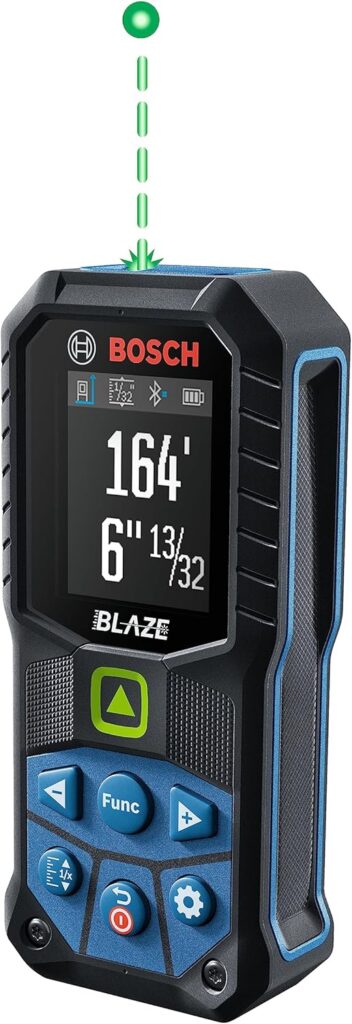
4.1. BOSCH GLM165-27CGL – Best Green-Beam Laser Distance Meter for Precision Physics Work
If you’re equipping a university or high school physics lab with a high-precision laser distance measuring tool, the BOSCH GLM165-27CGL is a fantastic pick. This model uses a green-beam laser, which is up to 4x brighter than standard red lasers, making it easier to see in well-lit lab environments. With ±1/16 inch accuracy and real-time measurement updates, this device is ideal for physics experiments requiring accurate distance measurement and repeatable positioning.
It comes with a 3.7V lithium-ion battery, belt clip, and pouch, making it portable and lab-friendly. Its IP65-rated durability means it can even handle fieldwork, making it versatile beyond indoor lab use.
Key Advantages:
- High accuracy: measures up to 165 feet with ±1/16 inch precision
- Green-beam visibility is superior in bright environments
- Backlit color display for use in low-light physics labs
- Real-time distance tracking – ideal for dynamic lab setups
- Works with the Bosch MeasureOn app for documentation & planning
- Rugged IP65-rated body for use in field research or mobile labs
Drawbacks:
- Slightly more expensive than basic red-beam models (~$169.88)
- Some students may find the app integration unnecessary for simple tasks
Bottom Line:
If your lab needs a laser distance meter for physics experiments where visibility, portability, and precision are crucial, the BOSCH GLM165-27CGL delivers excellent performance. It’s especially suitable for optics, motion, and kinematics experiments that require quick, accurate, and visual distance tracking.
🔗 This model typically costs around $169.88, but prices may vary Check it on Amazon.
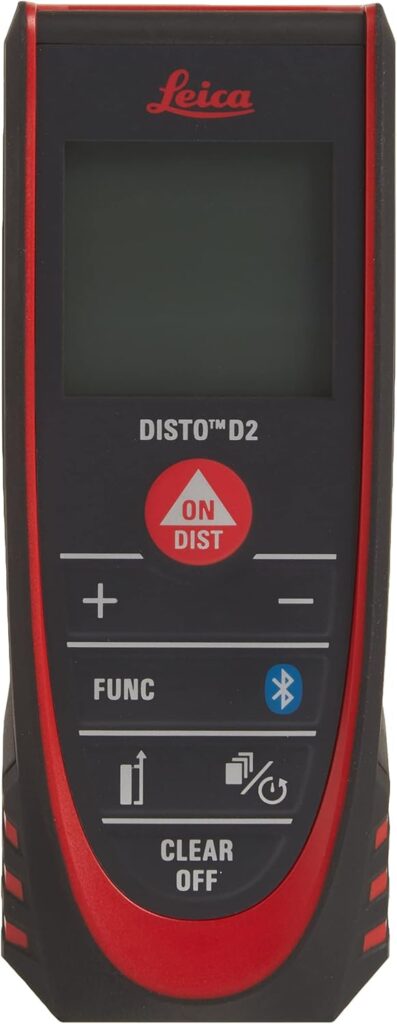
4.2. Leica DISTO D2 – Compact & Smart Laser Distance Meter for Physics Labs
If your physics lab needs a compact yet highly accurate laser distance meter, the Leica DISTO D2 is a solid choice. With an impressive 330-foot measuring range and ±1/16 inch accuracy, it’s suitable for precision experiments in optics, mechanics, and kinematics. Its Bluetooth 4.0 connectivity allows you to send measurements directly to your preferred software, streamlining lab documentation.
The Pythagoras function is especially useful for indirect measurements—perfect for when a direct line-of-sight is impossible, such as measuring heights or widths in complex setups. Its intelligent automatic end piece helps measure from corners and hard-to-reach spots with ease. Built with an IP54 rating, it’s resistant to dust and splashes, making it reliable for both indoor lab work and light field use.
Key Advantages:
- High accuracy: measures up to 330 ft (±1/16 inch precision)
- Bluetooth 4.0 for seamless data transfer to lab computers or tablets
- Pythagoras function for indirect height/width measurements
- Memory storage for last 10 measurements
- Compact and lightweight (4.57 x 1.73 x 1.02 in) for easy handling
- IP54-rated for dust and splash protection
Drawbacks:
- Plastic body is less rugged than some heavy-duty models
- Requires AAA batteries (included), which need periodic replacement
Bottom Line:
For physics labs that value portability, smart data transfer, and precise long-range measuring, the Leica DISTO D2 is an excellent tool. It’s particularly useful for experimental setups where direct measurement is tricky, making it a versatile choice for both lab and light field applications.
🔗 Typical Price: Around $181.34 (may vary) Check it on Amazon
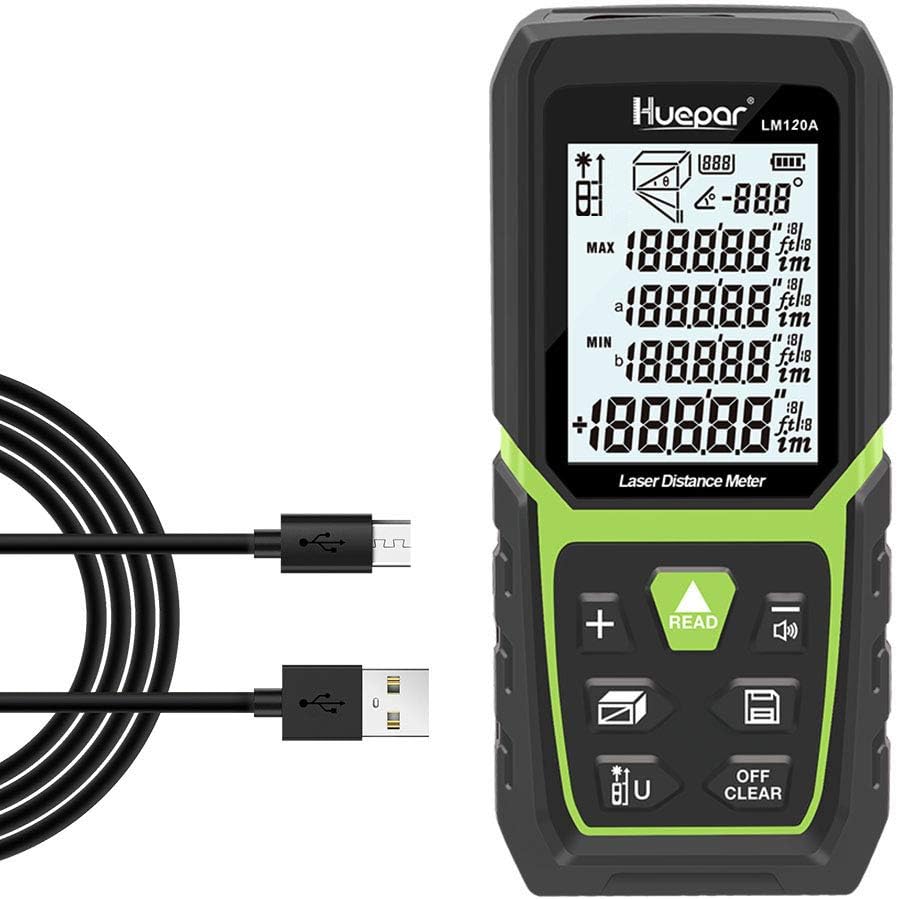
4.3. Huepar 393Ft Laser Distance Meter – Long-Range & Angle-Sensing Precision for Physics Labs
If your physics lab demands long-range measurements with high accuracy and added angle detection, the Huepar 393Ft Laser Distance Meter is a versatile and cost-effective choice. With an impressive 393-foot measuring range and ±1/16 inch accuracy, it handles precision work in optics, mechanics, and experimental geometry with ease.
Its built-in electronic angular sensor ensures faster and more precise angle readings compared to traditional bubble levels—particularly valuable in experiments involving inclined planes, projectile motion setups, or optical alignment. The integrated Li-ion rechargeable battery offers up to 8,000 measurements per charge, saving on battery costs and reducing waste.
The device features multiple measurement modes, including distance, area, volume, Pythagorean, continuous measurement, and calibration. Memory storage for up to 30 readings helps streamline repetitive measurements, while its IP54 dust and splash resistance makes it suitable for both clean lab environments and light outdoor use.
Key Advantages:
- Long range: measures up to 393 ft (±1/16 inch precision)
- Electronic angular sensor for accurate angle measurements
- Built-in Li-ion battery (USB rechargeable) with long life
- 30-data memory storage for repeated lab tasks
- Multiple units (m/in/ft) and modes (distance, area, volume, Pythagoras, continuous)
- IP54-rated for dust and splash protection
- Tripod mount compatible for stable long-distance measurements
Drawbacks:
- No Bluetooth connectivity for direct data transfer
- Slightly bulkier than some compact models
Bottom Line:
For physics labs that need both distance and angle precision in one device, the Huepar 393Ft Laser Distance Meter delivers professional-level performance at a budget-friendly price. Its rechargeable battery, extended range, and versatile measurement modes make it a reliable tool for a wide range of experimental setups.
🔗 Typical Price: Around $38.98 (may vary) Check it on Amazon
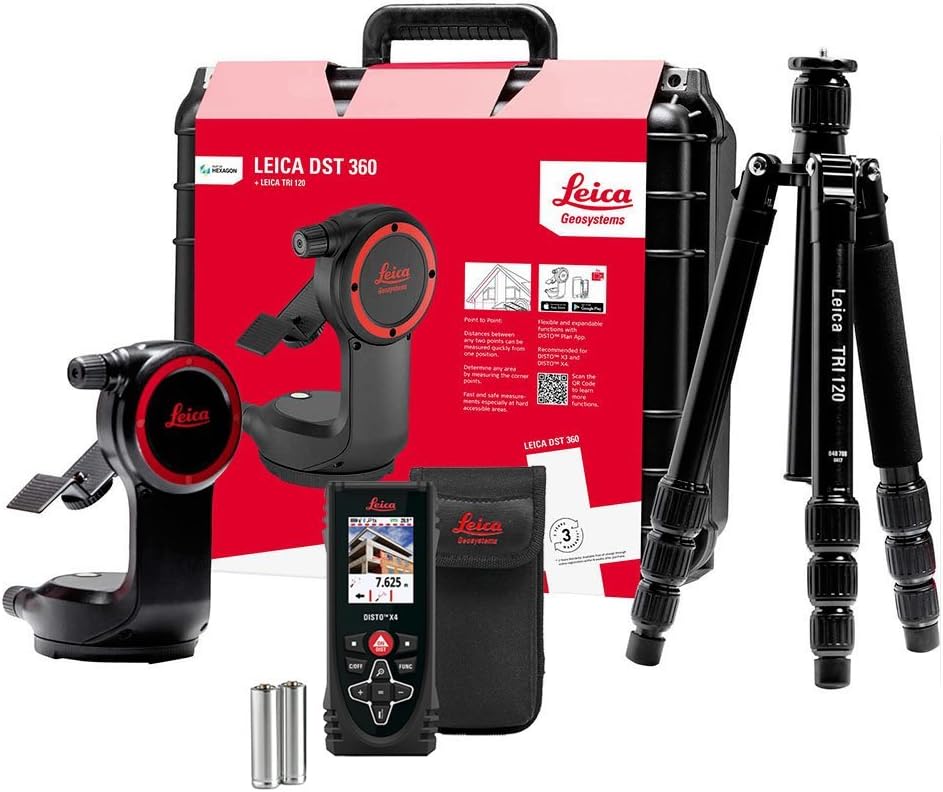
4.4. Leica DISTO X4 DST 360 Pro Pack – Advanced 3D Laser Distance Meter for Professional Physics Labs
If your physics lab requires not only precise distance measurements but also advanced 3D data capabilities, the Leica DISTO X4 DST 360 Pro Pack is a premium choice. Designed for demanding field and laboratory applications, this model comes with a robust build, high measurement accuracy, and integration with the DST 360 adapter for full 3D point measurement.
Its digital camera Pointfinder makes it ideal for outdoor experiments or long-range measurements where the laser dot is hard to see. The device offers quick distance and area calculations, while the data interface enables exporting 3D point coordinates directly into your preferred software for detailed analysis.
Built to last, the DISTO X4 is IP65-rated, providing protection against dust and water jets, and can handle harsh lab or outdoor conditions. The high-resolution color display ensures visibility in all lighting conditions, making it suitable for optics experiments, structural analysis, and precision engineering tasks.
Key Advantages:
- 3D measurement capability with DST 360 adapter for complex setups
- Digital camera Pointfinder for long-range and outdoor use
- Quick and accurate distance & area calculations
- Rugged IP65-rated construction for dust and water resistance
- High-visibility color display for easy reading in bright environments
- Ideal for both lab and field research applications
Drawbacks:
- High price point (around $1,159)
- Batteries not included
- Bulkier than simpler laser meters
Bottom Line:
The Leica DISTO X4 DST 360 Pro Pack is a top-tier tool for physics labs and engineering teams that need precise measurements in challenging conditions. Its 3D capability, advanced targeting system, and rugged build make it perfect for high-level research and professional applications.
🔗 Typical Price: Around $1,159 (may vary) Check it on Amazon
5. Conclusion
Laser distance meters have become essential tools for physics labs, offering unmatched accuracy, portability, and advanced features like Bluetooth data transfer and angle sensors. From budget-friendly models like the Huepar LM120A to professional-grade devices such as the Leica DISTO X4, there’s an option for every budget and application. By carefully considering your lab’s specific measurement needs—such as range, accuracy, durability, and connectivity—you can choose the right model to enhance your experiments and data collection efficiency.
6. Call to Action
Ready to upgrade your physics lab with precise, time-saving measurements? Check out these top laser distance meters:
- Check out the BOSCH GLM165-27CGL on Amazon
- Explore the Leica DISTO D2 here
- Buy the Huepar 393Ft Laser Distance Meter now
- Discover the Leica DISTO X4 DST 360 Pro Pack
FAQ – Best Laser Distance Meters for Physics Labs
1. Why use a laser distance meter in a physics lab?
Laser distance meters offer high precision, fast measurements, and digital data storage, making them perfect for experiments that require accurate distance calculations.
2. What is the typical accuracy of a laser distance meter?
Most high-quality models have an accuracy of ±1–2 mm, suitable for both academic and professional lab work.
3. Can laser distance meters measure angles or areas?
Yes. Many models include angle sensors, Pythagorean functions, and area/volume calculations to support more complex measurements.
4. Are laser distance meters safe to use indoors?
Absolutely—just ensure the device follows laser safety standards (Class II or Class IIa) and avoid direct eye exposure to the beam.
5. Do I need Bluetooth in my laser distance meter?
Bluetooth isn’t essential but is highly useful for transferring measurements directly to computers, tablets, or smartphones for analysis.