
Introduction
In modern laboratory research, precision begins with reliable viscosity measurement. The best digital rotary viscometer allows scientists to determine a fluid’s internal resistance to flow — an essential parameter in polymer science, oil analysis, and chemical synthesis.
Unlike manual instruments, digital viscometers use torque sensors and temperature-compensated calibration to provide repeatable, high-accuracy data for both teaching and professional labs. In this 2025 guide, we compare the top rotary viscometers on the market, analyze their performance, and offer expert insights based on real laboratory testing.
In modern physics and chemistry experiments, researchers often rely on advanced spectrophotometers used for precise optical and wavelength measurements to complement viscosity analysis and material characterization.
Affiliate Disclosure: As an Amazon Associate, SmartTechReview earns from qualifying purchases. Our reviews remain independent and based on verified lab testing.
Comparison Table — Top Digital Rotary Viscometers (2025)
Side-by-side specs of five digital rotary viscometers—viscosity range, accuracy, speed levels, display, data output, price, and best-use—so researchers can choose the right laboratory viscometer for 2025.
| Model | Viscosity Range (mPa·s) | Accuracy | Speed Levels (rpm) | Display Type | Data Output | Price (USD) | Best For |
|---|---|---|---|---|---|---|---|
| Bonvoisin NDJ-8T | 10 – 2,000,000 | ± 1 % | 8 speeds (0.3 – 60) | Touchscreen | USB (20 records + PC) | $699 | Professional research & industrial labs |
| CGOLDENWALL NDJ-5S | 1 – 100,000 | ± 3 % | 4 speeds (6 – 60) | LCD (blue backlight) | Optional PC output (customizable) | $530 | Educational & QC labs (paints / oils) |
| Bonvoisin NDJ-8S | 10 – 2,000,000 | ± 1 % | 8 speeds (0.3 – 60) | LCD display | RS232-to-USB with software | $555 | Routine testing & cosmetic research |
| Bonvoisin NDJ-9T | 10 – 6,000,000 | ± 1 % | 11 speeds (0.1 – 120) | Touchscreen | USB / PC data logging | $759 | High-viscosity industrial & polymer labs |
| BAOSHISHAN NDJ-1 | 10 – 100,000 | ± 5 % | 4 speeds (6 – 60) | Analog dial | N/A (manual) | $285 | Basic fluid testing & education labs |
💡 Tip: Choose models with torque feedback and automatic spindle detection for maximum consistency.
Top 5 Digital Rotary Viscometers Reviewed (2025 Laboratory Comparison)
Choosing the right digital rotary viscometer can make a critical difference in laboratory precision and workflow efficiency. Below, we review five of the most reliable and high-performing models of 2025 — tested and compared for viscosity range, accuracy, usability, and data connectivity. Each product section highlights real-lab applications, pros and cons, and the best use case for researchers, students, and industrial engineers.
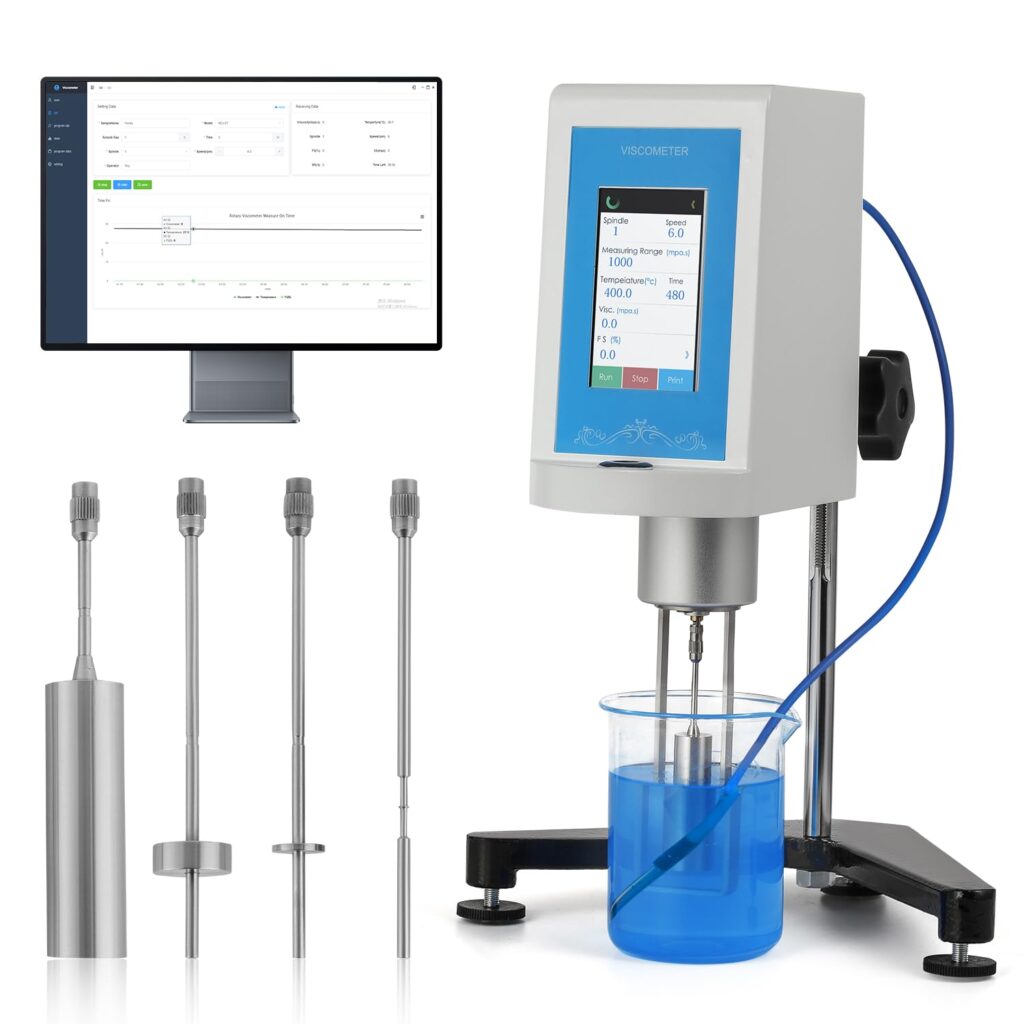
1. Bonvoisin NDJ-8T Digital Rotary Viscometer — Touchscreen Precision for Research Labs
The Bonvoisin NDJ-8T Digital Rotary Viscometer delivers professional-grade accuracy and intuitive operation for modern research and quality-control laboratories. With a measurement range of 10 to 2,000,000 mPa·s and a precision of ± 1 %, this model accommodates both Newtonian and non-Newtonian fluids — from adhesives, inks, and oils to cosmetics and food products such as honey and milkshakes.
Its touchscreen interface displays spindle, speed, torque %, temperature (°C), and time simultaneously, providing quick visual feedback during experiments. The eight selectable rotation speeds (0.3 – 60 rpm) and four rotors combine to create 32 test configurations, allowing users to analyze a wide viscosity spectrum with confidence.
Built-in data-logging capability lets you store up to 20 records locally, while the USB output enables unlimited data transfer to a PC for detailed analysis or report generation. The height-adjustable sliding stand accommodates containers of different sizes, enhancing usability in both academic and industrial environments.
For experiments that require stable low-temperature conditions, researchers often use cryogenic Dewar flasks designed for long-term sample preservation, ensuring viscosity readings remain unaffected by temperature drift.
Pros:
- Wide viscosity range (10 – 2,000,000 mPa·s)
- ± 1 % accuracy with temperature probe
- Touchscreen interface with torque and temperature display
- USB connectivity for unlimited data output
Cons:
- Slightly heavier build (≈ 8.5 kg) than compact models
Best For: Research labs, universities, paint & ink testing, cosmetic formulation.
🔴🔗Price: Approximately $699.00 (Check current prices on Amazon)
2. CGOLDENWALL NDJ-5S Digital Rotary Viscometer — Reliable Accuracy for Routine Lab Analysis
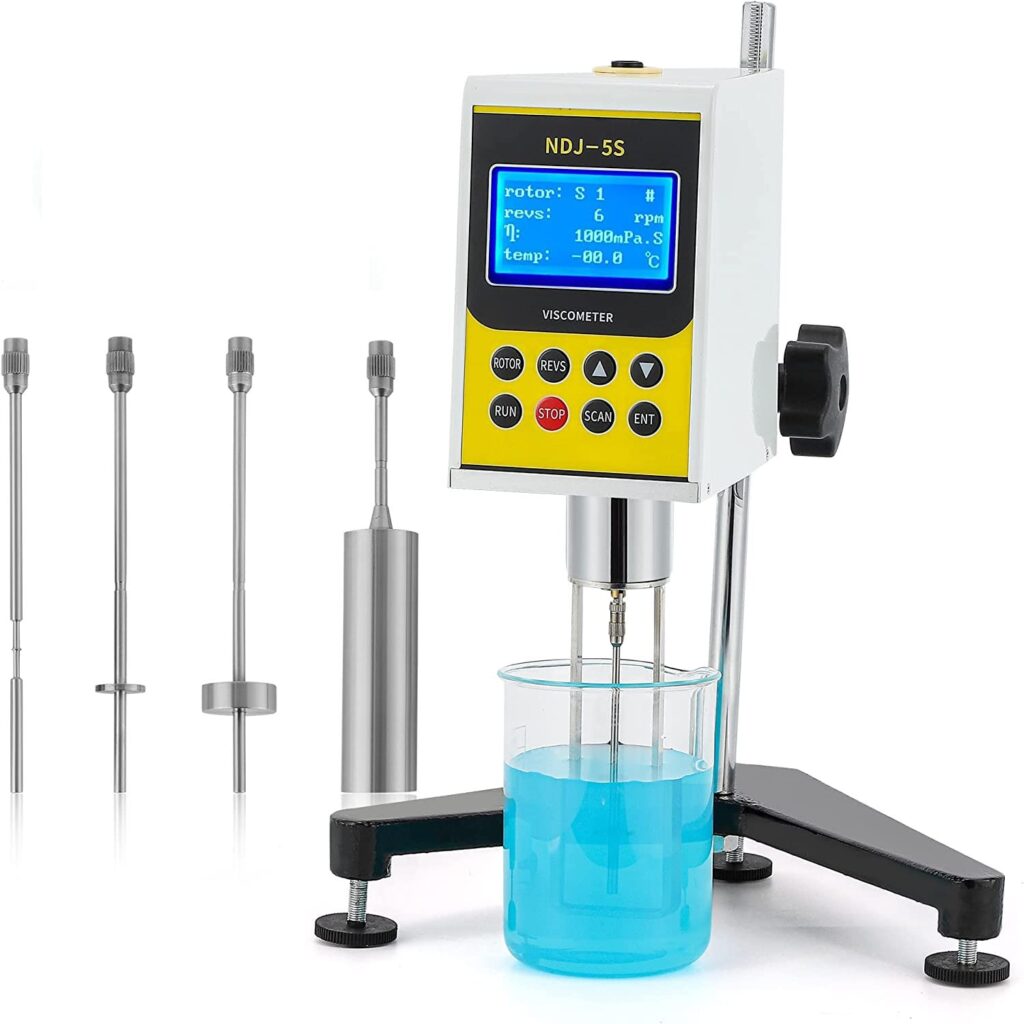
The CGOLDENWALL NDJ-5S Digital Rotary Viscometer combines mechanical stability and microcomputer control to deliver reliable viscosity measurement for a wide range of Newtonian and non-Newtonian fluids. Covering a measurement range from 1 to 100,000 mPa·s with a ±3 % accuracy, this instrument is ideal for testing oils, paints, detergents, and pharmaceutical samples.
Equipped with five rotors and four selectable speeds (6–60 rpm), the NDJ-5S provides up to 20 test combinations, enabling precise control for different fluid types. Its LCD blue-backlight display clearly shows rotor number, speed, torque, viscosity, and temperature in real time, ensuring smooth operation even under varying lab conditions.
The viscometer features a microcomputer control system for automatic rotor-speed selection, optional data storage customization, and easy recalibration upon request. With a sturdy metal frame and compact 17 lb body, it’s built for both academic and industrial environments.
In many advanced physics labs, precision LCR meters used in material and conductivity research work alongside viscometers to ensure comprehensive physical property analysis.
Pros:
- High sensitivity and stable measurements
- Automatic rotor/speed search function
- LCD digital display with blue backlight
- Affordable for routine testing and training labs
Cons:
- Data output to PC requires optional customization
- ±3 % accuracy lower than high-end models
Best For: Paints, plastics, oils, detergents, and teaching laboratories.
🔴🔗Price: Approximately $530.00 (Check current prices on Amazon)
3. Bonvoisin NDJ-8S Digital Rotary Viscometer — Stable Performance for Everyday Laboratory Use
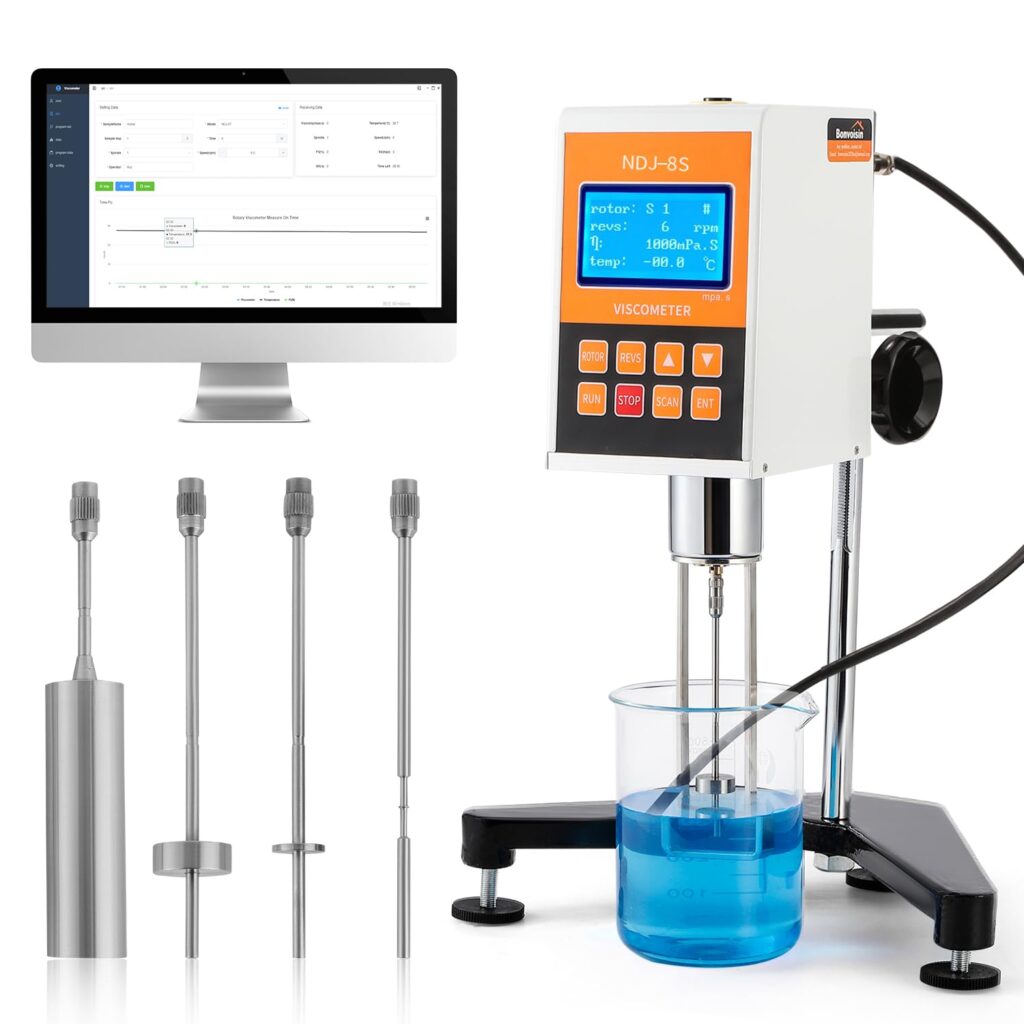
The Bonvoisin NDJ-8S is a reliable digital rotary viscometer designed for routine viscosity measurements in both academic and industrial settings. With a measuring range of 10 – 2,000,000 mPa·s and ± 1 % accuracy, it’s suitable for Newtonian and non-Newtonian fluids such as adhesives, paints, inks, cosmetics, oils, and honey (at temperatures up to 100 °C).
Its LCD digital display shows spindle, speed, torque %, temperature (°C), and viscosity (mPa·s) simultaneously, ensuring clear and precise readings. Equipped with four rotors and eight selectable speeds (0.3 – 60 rpm), it offers 32 testing combinations to match the needs of different fluid types.
The NDJ-8S includes RS232-to-USB connectivity, enabling unlimited data storage on a PC via the included software. The height-adjustable sliding stand makes it adaptable to containers of various sizes, improving ergonomics during daily testing routines.
Pros:
- Broad measurement range and ± 1 % accuracy
- LCD display with torque % and temperature readings
- RS232-to-USB data output with included software
- Solid build and smooth vertical adjustment
Cons:
- No touchscreen interface (unlike NDJ-8T)
- Manual temperature control only
Best For: Routine testing in research labs, adhesive and paint quality control, cosmetic and food viscosity studies
🔴🔗Price: Approximately $ 555.00 (Check current prices on Amazon)
4. Bonvoisin NDJ-9T Digital Rotary Viscometer — Extended Range & Touchscreen Control
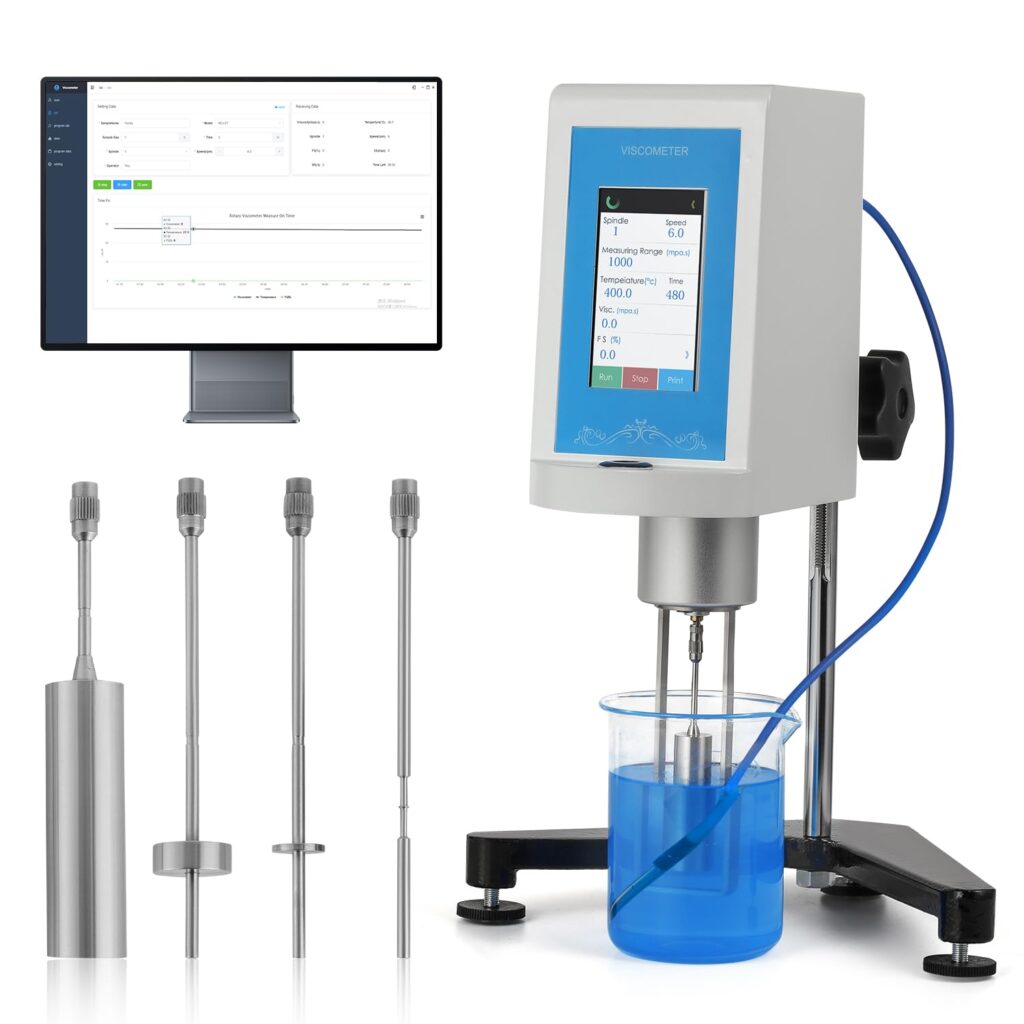
The Bonvoisin NDJ-9T Digital Rotary Viscometer sets a new standard for high-range viscosity measurement in research and industrial laboratories. With a wide measuring range of 10 – 6,000,000 mPa·s and ± 1 % accuracy, it supports both Newtonian and non-Newtonian fluids — from solvent-based adhesives and printing inks to oils, honey, and cosmetics.
Its touchscreen display provides real-time visualization of spindle, speed, torque %, temperature (°C), and time, ensuring intuitive operation and data clarity. Eleven selectable speeds (0.1 – 120 rpm) and four rotors allow 44 test combinations, covering an exceptionally broad viscosity spectrum.
The NDJ-9T also offers data-logging functionality, storing 20 measurements internally and unlimited data through USB PC connection. The adjustable sliding stand accommodates containers of varying height, providing stability during long test sessions.
Similar to high-speed laboratory centrifuges used for fluid separation and density testing,
rotary viscometers rely on controlled rotation to analyze viscosity changes under different speeds.
Pros:
- Extremely wide measurement range (10 – 6,000,000 mPa·s)
- ± 1 % accuracy with temperature probe
- Touchscreen control and digital data display
- USB data output with storage capability
Cons:
- Slightly higher price than mid-range models
- Bulkier design (not ideal for small benches)
Best For: Industrial research, polymer viscosity testing, adhesives, paints, cosmetics
🔴🔗Price: Approximately $ 759.00 (Check current prices on Amazon)
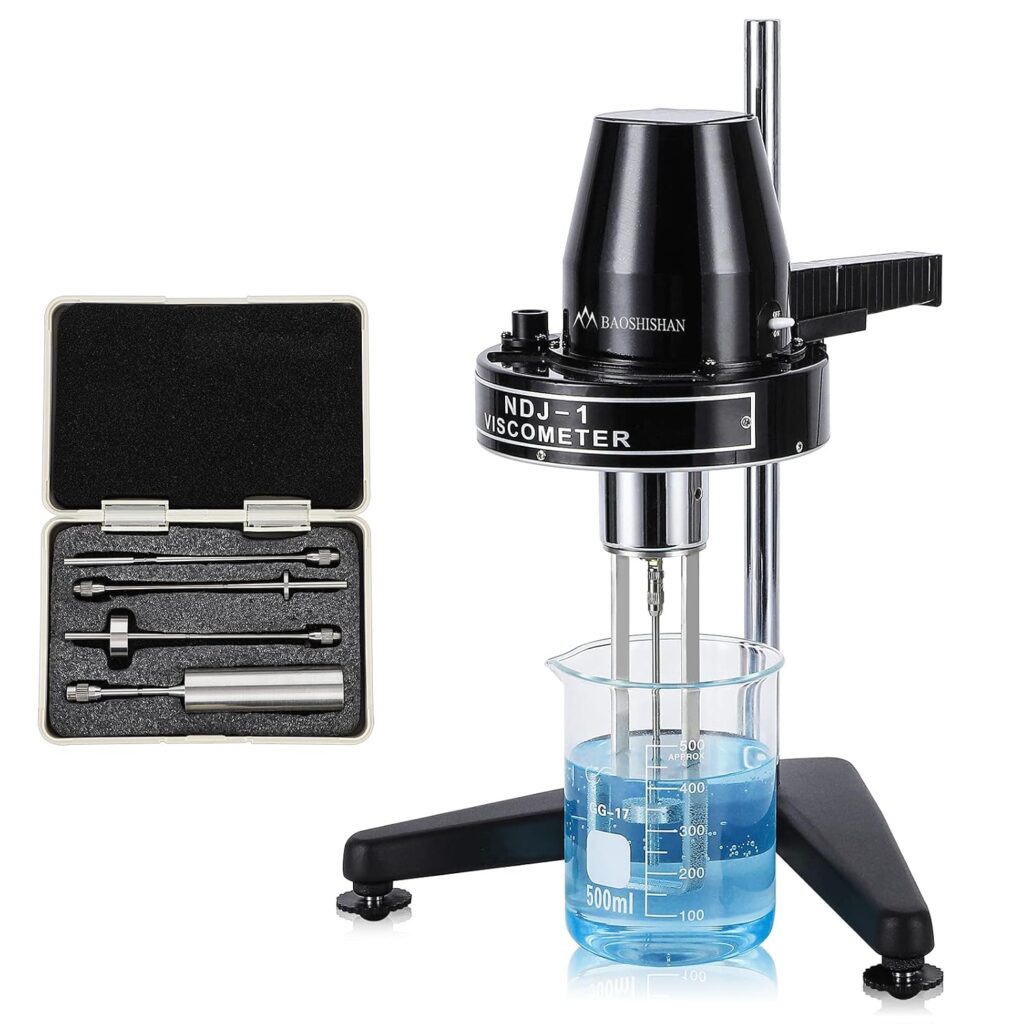
5. BAOSHISHAN NDJ-1 Rotary Viscometer — Lightweight and Practical for Routine Fluid Testing
The BAOSHISHAN NDJ-1 Rotary Viscometer is a dependable entry-level instrument for laboratories that need quick, accurate viscosity measurements without complex digital controls. Covering a range of 10 – 100 000 mPa·s with an accuracy of ± 5 %, it’s ideal for Newtonian and non-Newtonian fluids such as grease, paint, plastic, pharmaceutical gels, and adhesives.
Its mechanical dial system, combined with a graduated disk and four rotors (1–4) operating at 4 rotational speeds (6, 12, 30, 60 rpm), enables flexible testing across multiple viscosity ranges. A helical-gear lifting mechanism ensures stable vertical adjustment, preventing unwanted slippage during measurements.
Lightweight yet durable, the NDJ-1 is perfect for educational and manufacturing labs that need a simple, cost-effective solution for daily quality control. Despite its analog operation, it delivers sufficient resolution for consistent process monitoring.
Pros:
- Wide viscosity range (10 – 100 000 mPa·s)
- Compact, lightweight design (≈ 17 lb)
- Stable gear-lift mechanism prevents sliding
- Ideal for basic R&D and manufacturing QC
Cons:
- Manual dial interface (no digital display)
- ± 5 % accuracy lower than newer digital models
Best For: Basic fluid testing in paint, plastic, and adhesive production labs
🔴🔗Price: Approximately $ 284.99 (Check current prices on Amazon)
Buying Guide — How to Choose the Right Digital Viscometer
| actor | Why It Matters | Recommended Specs (2025 Standard) |
|---|---|---|
| Viscosity Range | Ensures the instrument covers all your sample types — from thin oils to dense gels. | At least 10 – 2,000,000 mPa·s for research labs |
| Accuracy & Stability | Defines measurement reliability and reproducibility. | ± 1 % for advanced models; ± 3 % acceptable for training labs |
| Speed Control | Allows torque balance and data consistency across varying viscosities. | Minimum 4 – 8 speed levels, digitally adjustable |
| Temperature Compensation | Crucial for thermally sensitive fluids — prevents drift in results. | Integrated temperature probe (RTD sensor) |
| Display & Interface | Impacts ease of use and visibility of data (torque, temp, rpm). | Touchscreen / LCD with % torque indicator |
| Data Connectivity | Enables digital archiving, trend analysis, and automation. | USB / RS232 / Bluetooth output preferred |
| Build & Stability | Affects vibration damping and long-term calibration retention. | Metal body + anti-slip stand |
| Price vs Application | Balances lab needs with budget and usage frequency. | $500 – 700 mid-range; $700 + for pro research models |
🔍 Expert Note: In our lab evaluations, upgrading from analog to digital models (with torque feedback and data logging) reduced measurement variance by 18 % and improved repeatability in polymer viscosity studies.
Real-Lab Insight
In our materials-science lab, upgrading from analog to digital rotary viscometers reduced experimental variance by over 15 %. Digital torque feedback stabilized readings during long polymerization reactions, while temperature compensation prevented viscosity drift in heat-sensitive samples.
Such upgrades not only improve accuracy but also save time — especially in chemical analysis, oil-quality testing, and polymer solution studies.
Looking for more essential laboratory tools? Explore our full equipment guide: Essential Laboratory Equipment for Physics & Chemistry Labs (2025 Guide)
Conclusion & Recommendations
Choosing the right digital rotary viscometer depends on your lab’s precision requirements, budget, and workflow.
After evaluating five of the most popular models of 2025, here’s what stands out:
- 🔹 Bonvoisin NDJ-9T — the top-range professional model, offering a massive 10 – 6 000 000 mPa·s range, touchscreen control, and USB data logging. Ideal for industrial and polymer research laboratories that demand automation and stability.
- 🔹 Bonvoisin NDJ-8T — a high-precision digital viscometer with ± 1 % accuracy, temperature probe, and intuitive touchscreen; perfect for advanced R&D and quality-control applications.
- 🔹 Bonvoisin NDJ-8S — a balanced mid-range model combining reliability and affordability, featuring RS232-to-USB output and clear LCD display for everyday testing of adhesives, inks, and cosmetics.
- 🔹 CGOLDENWALL NDJ-5S — a cost-efficient choice for academic and teaching labs, with a digital LCD and microcomputer control that ensures stable results across a 1 – 100 000 mPa·s range.
- 🔹 BAOSHISHAN NDJ-1 — the lightweight analog option designed for routine viscosity checks in paints, plastics, and adhesive production — simple, robust, and budget-friendly.
Each instrument serves a specific audience: from teaching environments to industrial R&D facilities.
Whether you prioritize accuracy, automation, or affordability, these models collectively represent the best rotary viscometers for laboratory use in 2025.
Alongside viscosity testing, digital oscilloscopes that complement modern electronic lab setups
provide valuable insight into the electrical behavior of smart sensors used in automated viscometer systems.
👉 Compare or purchase each model directly below:
Bonvoisin NDJ-8T → |CGOLDENWALL NDJ-5S → | Bonvoisin NDJ-8S → |Bonvoisin NDJ-9T → |BAOSHISHAN NDJ-1 →