
Choosing the best analytical balances for research and university laboratories is not just about readability — it’s about long-term precision, calibration reliability, and measurement stability under real laboratory conditions. When weighing reagents, reference materials, or high-value samples, even a 0.0001 g deviation can impact reproducibility and analytical accuracy.
Modern research laboratories require analytical balances that offer consistent repeatability, internal calibration systems, vibration resistance, and reliable performance across demanding workflows. Whether you are upgrading outdated weighing equipment or selecting a new balance for your university lab, comparing specifications alone is not enough — build quality, stability, and long-term reliability matter just as much.
In this 2026 precision buying guide, we compare the best analytical balances available today, focusing on accuracy, capacity, calibration type, usability, and overall value — so you can confidently choose the right model for your laboratory.
Analytical balances are commonly used alongside high-precision instruments such as laboratory pH meters and benchtop conductivity meters, particularly in analytical and research laboratories where solution accuracy and reproducibility are critical.
Comparison of the Best Analytical Balances for Research & University Laboratories (2026)
Choosing the right analytical balance depends on more than just readability. Capacity, interface design, long-term stability, compliance features, and overall laboratory suitability all play a critical role in daily research workflows. The comparison table below provides a side-by-side overview of the leading institutional analytical balances in 2026, helping you quickly identify which model aligns best with your laboratory requirements and budget.
| Model | Capacity | Readability | Interface | Best For | Approx. Price | Visit product page |
|---|---|---|---|---|---|---|
| OHAUS Explorer Plus EXP | 120–220 g | 0.01 mg / 0.1 mg | 7″ Touchscreen | Advanced Research Labs | ~$6,500+ | Check product page |
| OHAUS Pioneer PX224 | 220 g | 0.0001 g | LCD | University Laboratories | ~$3,000–4,000 | Check price on amazon |
| Adam Luna LAB 214e | 210 g | 0.0001 g | touchscreen | Teaching & Routine Research | ~$2,500–3,000 | Check price on amazon |
| OHAUS Adventurer AX224/E | 220 g | 0.0001 g | Color Touchscreen | Modern Institutional Labs | ~$4,000–4,500 | Check price on amazon |
In-Depth Reviews of the Best Analytical Balances (2026)
The following section presents in-depth evaluations of the best analytical balances currently available for research and university laboratories. Each model has been assessed based on precision (0.0001 g readability), weighing capacity, calibration system, build quality, and overall value for long-term laboratory use. Rather than listing specifications alone, we focus on real-world performance, stability, and suitability for demanding research environments — helping you determine which balance truly fits your workflow.
For laboratories prioritizing cost-efficiency or teaching-focused applications, you may also consider our comparison of affordable analytical balances for university and small laboratories.
1.OHAUS Explorer Plus™ EXP Series (Semi-Micro / Analytical Flagship)
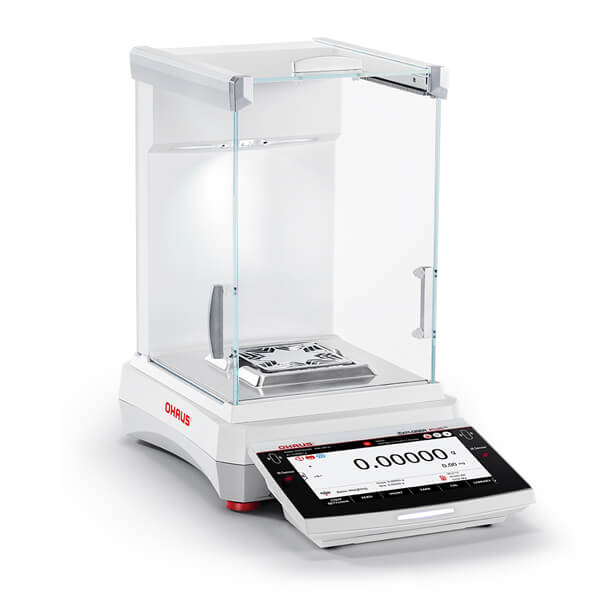
The OHAUS Explorer Plus™ EXP Series represents a flagship-class laboratory balance designed for advanced analytical and semi-micro applications. Positioned above entry-level analytical models, the EXP series is built for research environments that require ultra-stable performance, regulatory compliance support, and high-level data traceability. With its modular construction, advanced connectivity options, and intelligent user management system, it is engineered to meet the demands of modern scientific laboratories.
Key Specifications
- Readability: 0.1 mg (0.0001 g) or 0.01 mg (semi-micro variants)
- Capacity: Varies by model (commonly 120 g / 220 g)
- Weighing Technology: Electromagnetic Force Restoration (EMFR)
- Calibration: Internal automatic calibration
- Display: 7-inch full-color TFT touchscreen
- Connectivity: USB (A/B/C), RS232, Ethernet; optional Wi-Fi & Bluetooth
- Draftshield: Anti-static glass draftshield with automatic doors
- Special Features: Built-in ionizer, motorized leveling, touchless sensors
Standout Features
Advanced Compliance & Data Traceability
The EXP Series supports user-level management (up to 4 access levels), internal logging (up to 100,000 entries), and time synchronization via NTP. These features make it particularly suitable for regulated laboratory environments.
Integrated Ionizer & Anti-Static Design
Electrostatic interference is a common issue in high-precision weighing. The built-in ionizer helps reduce static-related instability, improving repeatability when weighing fine powders or lightweight samples.
Motorized Leveling & Touchless Operation
Automatic leveling and touchless sensors enhance usability while reducing mechanical disturbance — an important factor in maintaining consistent micro-level readings.
Pros
✔ Flagship-level stability and repeatability
✔ Semi-micro capability in select variants
✔ Advanced connectivity for LIMS integration
✔ Built-in ionizer for electrostatic control
✔ High-resolution touchscreen interface
✔ Designed for regulated research workflows
Cons
✖ Significantly higher cost compared to standard analytical balances
✖ Advanced features may exceed the needs of basic teaching laboratories
✖ Larger footprint than compact entry-level models
Performance in Advanced Research Laboratories
In high-precision analytical workflows, balances in the Explorer Plus class are valued for their long-term stability, minimal drift, and resistance to environmental interference. The EMFR weighing system combined with anti-static shielding and motorized leveling contributes to consistent repeatability across extended laboratory sessions. For applications such as semi-micro weighing, density determination, formulation, and regulated analytical procedures, this level of engineering provides measurable workflow advantages over standard analytical balances.
Best For
- Advanced university research laboratories
- Pharmaceutical and regulated analytical environments
- Laboratories requiring semi-micro precision
- High-throughput workflows with data traceability needs
🔴🔗 View the official OHAUS Explorer Plus™ EXP specifications
After reviewing this flagship-class balance, we now examine more accessible analytical models that maintain 0.0001 g precision while offering a lower investment threshold.
2. OHAUS Pioneer PX224 Analytical Balance (220 g × 0.0001 g)
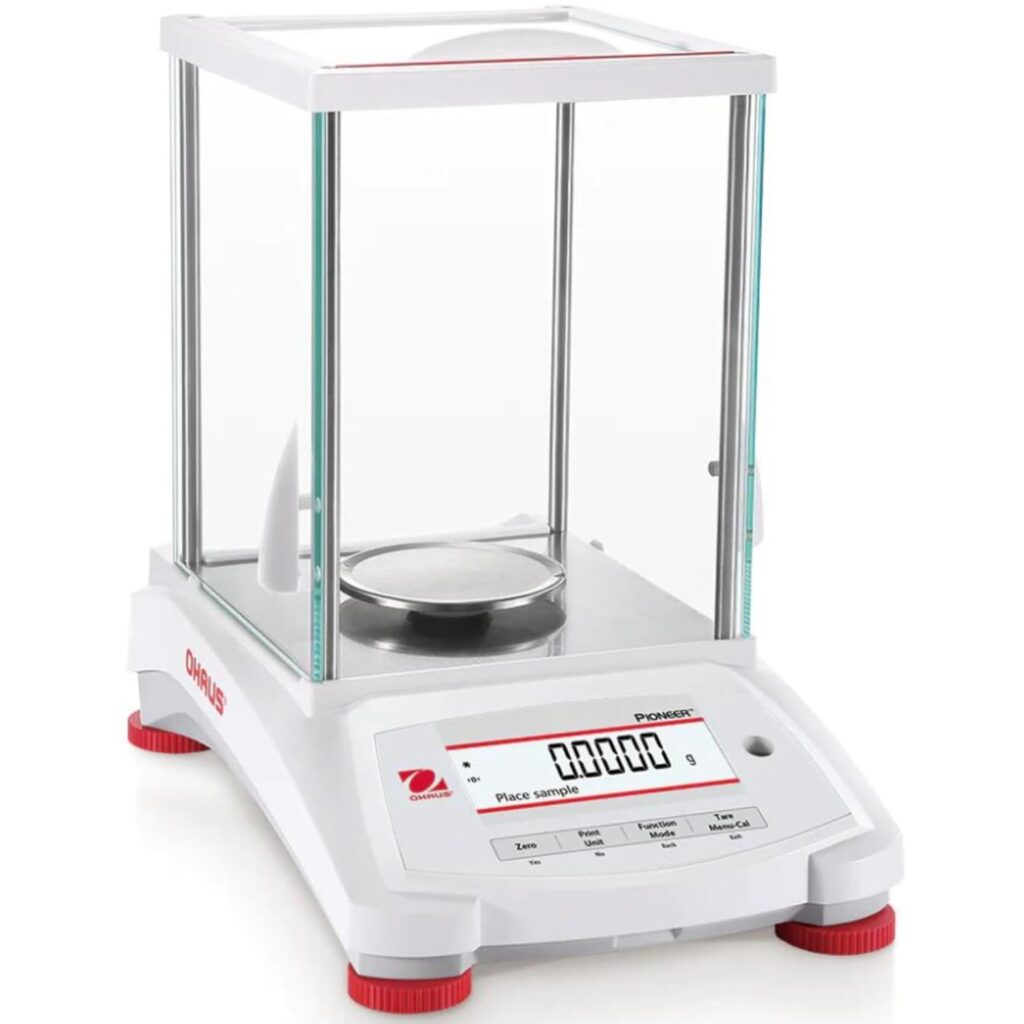
The OHAUS Pioneer PX224 is a widely adopted analytical balance designed for university laboratories, research facilities, and quality control environments requiring reliable 0.0001 g precision. Positioned below flagship semi-micro models, the PX224 delivers stable electromagnetic force restoration (EMFR) performance in a more accessible and cost-effective platform. It is particularly suitable for academic institutions and laboratories seeking consistent repeatability without the advanced complexity of high-end flagship systems.
Key Specifications
- Readability: 0.0001 g (0.1 mg)
- Maximum Capacity: 220 g
- Weighing Technology: Electromagnetic Force Restoration (EMFR)
- Display: 2-line LCD with backlight
- Dimensions: 321 × 309 × 209 mm
- Draftshield: Glass draftshield enclosure
- Units: g, mg, oz, ozt, ct, lb, Newton, Tola, Tael variations, and more
- Operating Temperature: 5°C – 40°C
- Humidity Range: Up to 80% RH (non-condensing)
Standout Features
Proven EMFR Stability
The PX224 uses electromagnetic force restoration technology, ensuring consistent repeatability and reduced drift during extended laboratory sessions.
University-Friendly Interface
The 2-line LCD display provides clear readouts without unnecessary complexity — making it ideal for teaching labs and daily analytical workflows.
Broad Unit Flexibility
With multiple international measurement units available, it supports research, trade, and formulation applications.
Controlled Environmental Performance
Operational stability across common laboratory temperature and humidity ranges ensures dependable performance in academic settings.
Pros
✔ Reliable 0.0001 g precision for analytical applications
✔ Well-established OHAUS brand reputation
✔ Suitable for teaching and research laboratories
✔ Strong stability-to-cost ratio
✔ Institutional-grade build quality
Cons
✖ Lacks advanced touchscreen interface found in flagship models
✖ No built-in ionizer
✖ Fewer compliance automation features compared to EXP series
Performance in University & Research Laboratories
In academic and research environments, the Pioneer PX224 is frequently selected for its balance between precision, durability, and cost efficiency. The EMFR system provides stable micro-level measurements suitable for gravimetric analysis, reagent preparation, density determination, and general analytical procedures. While it does not include the advanced automation features of flagship models, it offers dependable performance for the majority of university-level analytical tasks.
Best For
- University teaching laboratories
- Research labs requiring 0.0001 g precision
- Quality control environments
- Laboratories seeking institutional reliability at a lower cost than flagship systems
🔴🔗Check current pricing for the OHAUS Pioneer PX224 on Amazon
3. Adam Equipment Luna LAB 214e Analytical Balance (210 g × 0.0001 g)
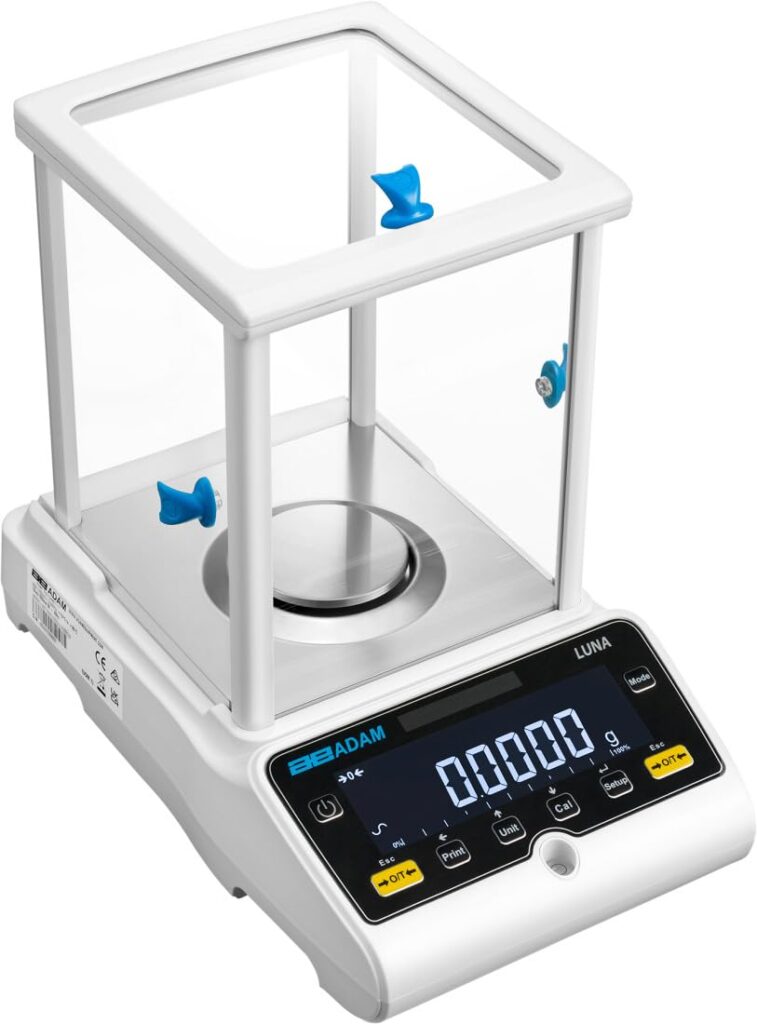
The Adam Equipment Luna LAB 214e is a mid-tier analytical balance designed for university laboratories, clinical environments, and routine research workflows requiring dependable 0.0001 g precision. Positioned between flagship institutional systems and entry-level analytical models, the LAB 214e provides reliable electromagnetic weighing performance in a more cost-accessible platform. It is particularly well-suited for academic laboratories and daily analytical procedures where consistency and durability are essential.
Key Specifications
- Readability: 0.0001 g (0.1 mg)
- Maximum Capacity: 210 g
- Display: digital, touchscreen
- Calibration: Internal (model-dependent; confirm version)
- Leveling: Adjustable feet with built-in level indicator
- Operating Interface: Color-coded tactile keys
- Intended Use: Laboratory, clinical pathology, chemistry, microbiology
Standout Features
Balanced Performance-to-Cost Ratio
The LAB 214e delivers true analytical-grade readability while remaining more budget-conscious than flagship models — making it attractive for universities and teaching labs.
Clear, Backlit Display
The vivid LCD ensures easy readability in various laboratory lighting conditions without the complexity of touchscreen systems.
Practical Laboratory Design
Color-coded keys streamline daily operation, and the built-in leveling indicator ensures proper setup for optimal precision.
UK Engineering with US Support
Adam Equipment designs its balances in the UK and provides regional support, offering an added layer of reliability for institutional buyers.
Pros
✔ Reliable 0.0001 g analytical precision
✔ Strong reputation in educational and laboratory markets
✔ More affordable than flagship OHAUS models
✔ Straightforward, user-friendly interface
✔ Stable performance for routine gravimetric analysis
Cons
✖ Less advanced automation compared to high-end systems
✖ Fewer connectivity options than flagship models
Performance in Academic & Routine Research Settings
In everyday laboratory environments, the Luna LAB 214e offers dependable repeatability for standard analytical procedures, including reagent preparation, formulation, density determination, and quality control tasks. While it does not include advanced compliance logging or automated draftshield systems found in premium balances, it provides stable micro-level measurements suitable for the majority of university-level analytical applications.
Best For
- University teaching laboratories
- Clinical pathology labs
- Routine analytical workflows
- Institutions seeking precision with controlled budgets
🔴🔗Check current pricing for the Adam Luna LAB 214e on Amazon
4. Ohaus Adventurer AX224/E (220 g × 0.0001 g)
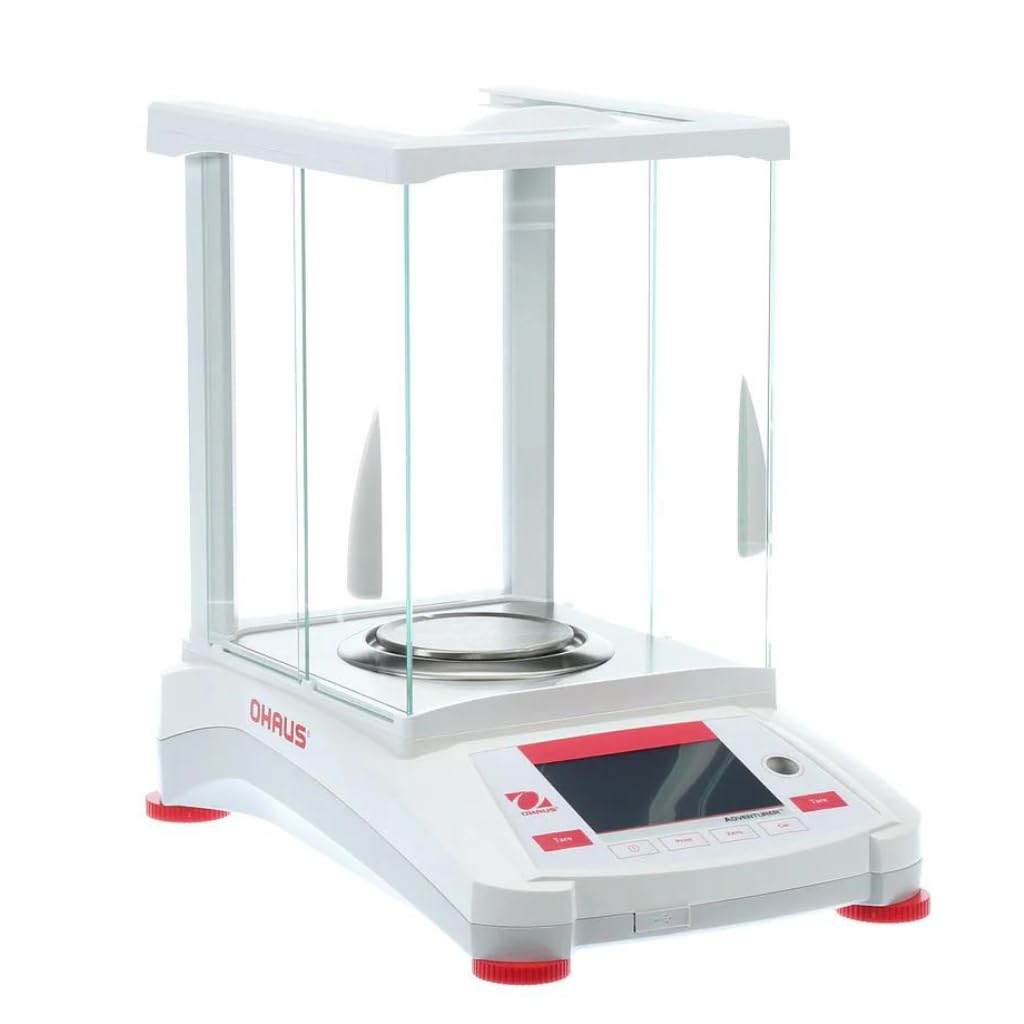
The Ohaus Adventurer AX224/E represents a modern institutional analytical balance designed for research laboratories, academic institutions, and industrial quality-control environments. Positioned between entry-level analytical balances and flagship semi-micro systems, the AX224 delivers dependable 0.1 mg precision with advanced usability and compliance-ready data handling.
Key Specifications
- Capacity: 220 g
- Readability: 0.0001 g (0.1 mg)
- Interface: Color touchscreen with icon-based navigation
- Connectivity: USB, RS232
- Compliance Support: GLP/GMP with real-time clock
- Construction: Metal base, ABS housing, stainless steel pan
- Draftshield: Glass enclosure with sliding doors
Key Features Explained
Intuitive Touchscreen Interface
The full-color touchscreen simplifies method setup, calibration, and mode switching — particularly useful in multi-user university labs.
Versatile Weighing Modes
Supports multiple application modes including parts counting, percent weighing, check weighing, and dynamic weighing — making it adaptable across chemistry, materials science, and QC workflows.
Efficient Data Management
USB and RS232 connectivity allow seamless data transfer. GLP/GMP record support ensures traceability for regulated research environments.
Durable Construction
Metal base and stainless-steel pan provide long-term stability. The glass draftshield reduces airflow interference while maintaining visibility.
Environmental Filters & Auto-Tare
Selectable environmental filters improve stability in non-ideal lab conditions. Auto-tare speeds up repetitive weighing tasks.
Pros
✔ Reliable 0.0001 g performance
✔ Modern touchscreen interface
✔ Strong brand credibility (Ohaus)
✔ GLP/GMP data support
✔ Suitable for academic & research labs
Cons
✖ Higher price compared to mid-tier models
✖ Not semi-micro precision (0.01 mg)
✖ Larger footprint than compact budget models
Lab Performance Insight
In academic research laboratories, the AX224 performs consistently under standard environmental conditions. Stabilization time is fast, repeatability is dependable, and touchscreen navigation improves workflow efficiency — especially in shared lab environments.
While not designed for ultra-trace semi-micro analysis, it excels in:
- Pharmaceutical formulation labs
- University analytical chemistry labs
- Materials characterization workflows
- Industrial quality-control environments
Best For
- University research laboratories
- Regulated laboratory environments
- Multi-user academic labs
- Industrial QC departments
🔴🔗Check current pricing for the Ohaus Adventurer AX224/E on Amazon
How to Choose the Best Analytical Balance for Your Laboratory
Selecting the best analytical balance for a research or university laboratory involves far more than comparing price tags. True laboratory-grade precision depends on multiple technical parameters — including readability, repeatability, environmental stability, calibration system, and workflow integration. The right balance is not simply the most precise model available, but the one that aligns with your laboratory’s analytical requirements, regulatory standards, and daily operational demands.
In many analytical workflows, balances operate alongside advanced measurement instruments such as laboratory spectrophotometers, where accuracy in sample preparation directly influences optical measurement reliability.Below are the critical factors that professionals evaluate before selecting an analytical balance.
1. Readability vs. Real Precision
Readability (e.g., 0.0001 g or 0.01 mg) indicates the smallest displayed increment — but it does not automatically guarantee measurement stability.
- 0.0001 g (0.1 mg) is sufficient for most university and analytical chemistry labs.
- 0.01 mg (semi-micro) is required for ultra-trace analysis and advanced research applications.
For most academic laboratories, a stable 0.1 mg analytical balance provides the optimal balance between performance and cost.
2. Capacity and Sample Workflow
Capacity must match your real workflow — not theoretical needs.
- 120–220 g models are standard for analytical chemistry labs.
- Lower-capacity models may be suitable for micro-sample applications.
- Higher capacity improves versatility for teaching laboratories.
Choosing excessive capacity without necessity increases cost without improving accuracy.
3. Environmental Control & Draft Shield Design
Airflow, vibration, electrostatic charge, and temperature shifts significantly influence analytical measurements.
Look for:
- Glass draft shields
- Anti-static features
- Environmental filters
- Stable leveling systems
4. Calibration System (Internal vs. External)
- Internal automatic calibration improves long-term reliability and reduces user error.
- External calibration requires manual weight standards but may reduce initial cost.
For shared university labs, internal calibration is generally preferred.
5. Data Management & Compliance
Modern research environments increasingly require:
- GLP/GMP documentation
- USB or RS232 connectivity
- Real-time clock support
- Traceable data logs
If your laboratory operates under regulated protocols, compliance-ready balances significantly simplify documentation workflows.
6. User Interface & Multi-User Environments
In academic laboratories, usability matters.
- Touchscreen interfaces improve workflow speed.
- Color-coded keys reduce operator error.
- Simple menu structures support student training.
A balance that is technically advanced but difficult to operate reduces overall lab efficiency.
7. Long-Term Stability & Brand Reliability
Not all 0.0001 g balances are engineered equally.
Established laboratory brands typically provide:
- Better repeatability
- More stable load-cell systems
- Longer operational lifespan
- Reliable technical support
For institutional investment, build quality often outweighs minor feature differences.
Final Recommendation
The best analytical balance for your laboratory is one that matches:
- Your required readability
- Your typical sample mass
- Your regulatory environment
- Your budget range
- Your operational complexity
High-end research labs may benefit from advanced semi-micro systems, while most university laboratories achieve excellent results with well-engineered 0.0001 g analytical balances.
Frequently Asked Questions About Analytical Balances
An analytical balance typically offers 0.0001 g (0.1 mg) readability and includes a draft shield to minimize environmental interference. A precision balance, by contrast, usually provides lower resolution (e.g., 0.01 g or 0.001 g) and is designed for less sensitive laboratory applications. Analytical balances are used for gravimetric analysis, reagent preparation, and high-accuracy laboratory measurements.
Yes. For most university chemistry and research laboratories, 0.0001 g (0.1 mg) readability is fully sufficient. Semi-micro balances (0.01 mg) are generally required only for ultra-trace analysis or advanced pharmaceutical research applications.
Analytical balances are highly sensitive to airflow and vibration. Glass draft shields reduce air currents and environmental disturbances, improving measurement stability and repeatability.
Calibration frequency depends on laboratory policy and regulatory requirements. In academic laboratories, calibration is often performed daily or before critical measurements. Models with internal automatic calibration simplify this process and reduce user error.
Most research laboratories operate comfortably with 120 g to 220 g analytical balances. Selecting capacity should reflect typical sample mass rather than maximum theoretical load.
Touchscreen balances offer improved usability and faster workflow in multi-user environments. However, LCD-based analytical balances remain reliable and cost-effective for routine laboratory tasks. The choice depends on budget and operational complexity.
Yes. Many institutional-grade analytical balances support GLP/GMP documentation, real-time clock integration, and data connectivity options such as USB or RS232, making them suitable for regulated laboratory workflows.
If you’re building or upgrading a complete laboratory setup, you may also find our guide to essential laboratory equipment for physics and chemistry laboratories helpful for planning a fully integrated research workspace.
Final Thoughts: Choosing the Right Analytical Balance in 2026
Selecting the best analytical balance for a research or university laboratory is ultimately a matter of aligning technical precision with real-world workflow demands. While readability is often the first specification considered, true laboratory performance depends on stability, environmental control, calibration reliability, and long-term durability.
For advanced research environments requiring semi-micro capability and enhanced compliance features, flagship systems such as the Explorer series offer unmatched performance. For most university laboratories and institutional settings, well-engineered 0.0001 g analytical balances provide an ideal balance between precision and investment. Mid-tier and modern touchscreen models further expand usability without compromising core measurement integrity.
The key is not choosing the most expensive model — but selecting the one that fits your laboratory’s operational complexity, regulatory requirements, and analytical depth.
In 2026, analytical balance technology continues to evolve toward greater usability, connectivity, and measurement stability. Investing in a properly matched laboratory balance is not merely a purchase decision — it is a foundational component of accurate scientific work.