Choosing the right Benchtop Conductivity Meter for Laboratory Use is rarely about learning what conductivity means — most researchers, lab instructors, and purchasing managers already know exactly why they need one. The real challenge is selecting a reliable instrument that delivers consistent, high-accuracy readings across daily lab routines, whether you’re preparing electrolyte solutions, monitoring water purity, or running quality control measurements in a university setting.
In practice, not all benchtop conductivity meters perform the same once they are placed on a busy laboratory bench. Factors like calibration stability, temperature compensation, probe durability, and data handling can make a noticeable difference over months of real use. That’s why investing in the right model is less about extra features on paper, and more about choosing a meter that fits the workflow and precision demands of your lab.
This guide reviews the best benchtop conductivity meters for chemistry and physics laboratories in 2025, focusing on what matters most for professional buyers: measurement accuracy, long-term reliability, and practical usability in research and teaching environments. If you’re looking to confidently select the right EC meter for your lab — without wasting time on basic explanations — you’re in the right place.
Quick Comparison: Top Benchtop Conductivity Meters for Labs (2026)
When lab managers and researchers compare benchtop conductivity meters, the decision rarely comes down to brand name alone. In real laboratory settings, performance differences become clear through factors like measurement accuracy, long-term stability, calibration convenience, temperature compensation, and how easily the instrument fits into daily bench workflows.
Before moving into the detailed review of each recommended model in the next section, the table below provides a quick, practical side-by-side comparison of the key specifications that matter most for professional lab buyers.
⭐ Best Overall Choice for University & Research Labs (2026): Apera AI502 EC700
If you need a reliable benchtop conductivity meter for daily laboratory use, the Apera AI502 EC700 stands out as the best balanced option in this guide. It offers stable readings, guided 1–4 point auto calibration, and a high-quality ATC electrode — making it an excellent fit for chemistry and physics labs.
Detailed Reviews: The Best Benchtop Conductivity Meters for Laboratory Use (2026)
Selecting the right benchtop conductivity meter for laboratory use is an important step for any chemistry or physics lab that relies on accurate EC measurement in daily workflows. Whether you are purchasing a laboratory conductivity meter for water testing, preparing electrolyte solutions, or managing routine quality control, the best choice depends on key factors such as measurement range, calibration stability, temperature compensation, and long-term reliability. In the detailed reviews below, we highlight the best benchtop conductivity meters of 2026 — focusing on research-grade performance, practical usability, and the models most suitable for university labs and professional laboratory environments.
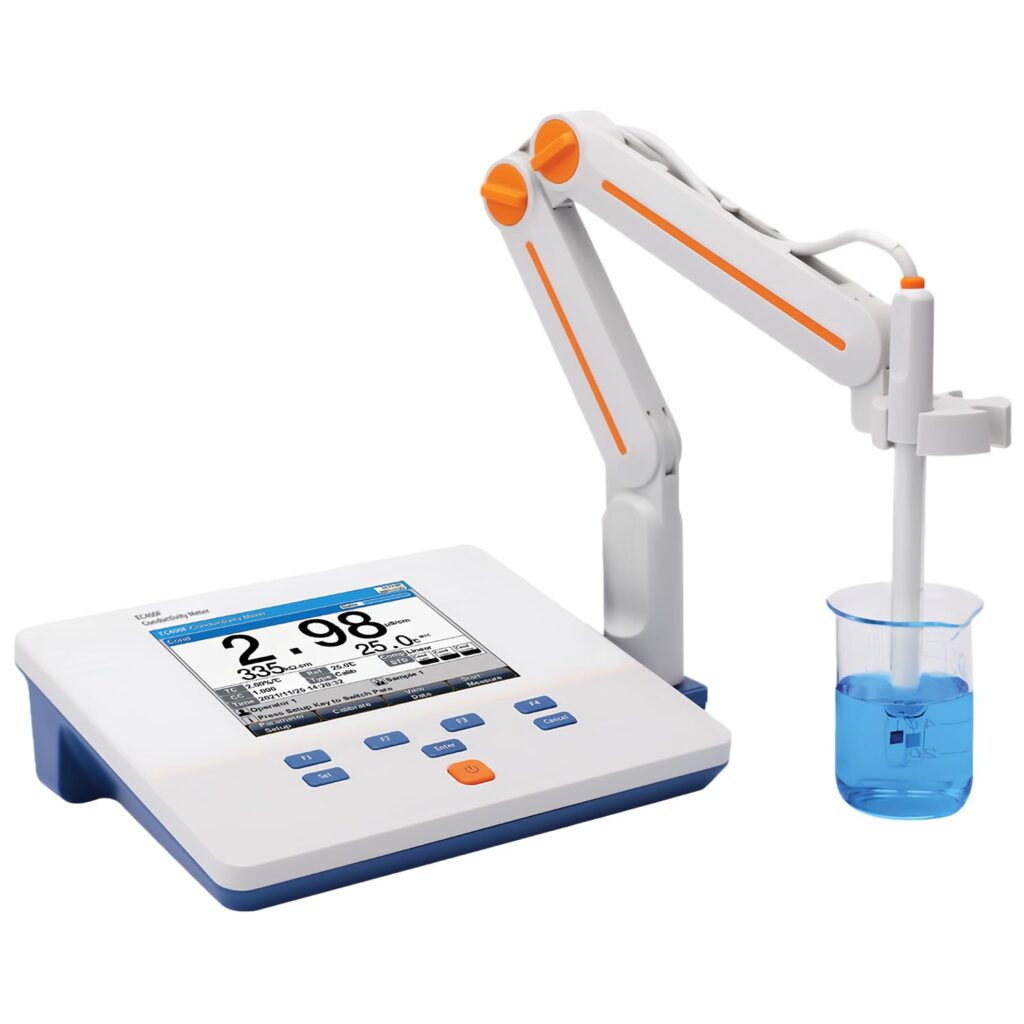
Supmea EC400F High-Precision Benchtop Conductivity Meter
A solid mid-range benchtop option designed for laboratories that need reliable conductivity measurements alongside multi-parameter flexibility. With its wide measurement range and professional data handling, the EC400F fits well in university teaching labs and routine research environments.
⭐ Key Features
Wide Conductivity Range: 0.000 μS/cm to 1000 mS/cm, covering ultrapure water up to high-salinity solutions
High Accuracy Performance: ±0.5% FS accuracy for critical lab and industrial EC measurements
Multi-Parameter Measurement: Supports conductivity, TDS, salinity, resistivity, and temperature
3-Point Calibration System: Automatic standard recognition improves calibration consistency
Advanced Data Handling: 500-data storage capacity, GLP support, and USB/RS-232 connectivity
Lab-Ready Durability: IP54 protection with stable lock readings and rugged housing for daily bench use
⭐ Pros
Excellent measurement range for both low and high conductivity samples
Multi-parameter support adds strong value for water quality and solution analysis
Professional-grade outputs (USB/RS-232) useful for documentation and reporting
IP54-rated design offers extra reliability in busy lab environments
⭐ Cons
Not as widely established as premium brands like Hanna or Thermo Scientific
±0.5% FS accuracy is strong, but top-tier research labs may still prefer higher-end models
Interface and software ecosystem may feel basic compared to flagship laboratory meters
⭐ Lab Test Result
In routine lab workflows, the EC400F performs best as a stable daily-use benchtop meter for water testing, electrolyte preparation, and multi-parameter solution checks. The automatic calibration recognition and data storage features make it particularly suitable for university labs where multiple users rely on consistent, repeatable measurements.
The Supmea EC400F is a high-precision benchtop conductivity meter designed for daily laboratory use, supporting EC, TDS, salinity, and temperature measurements.
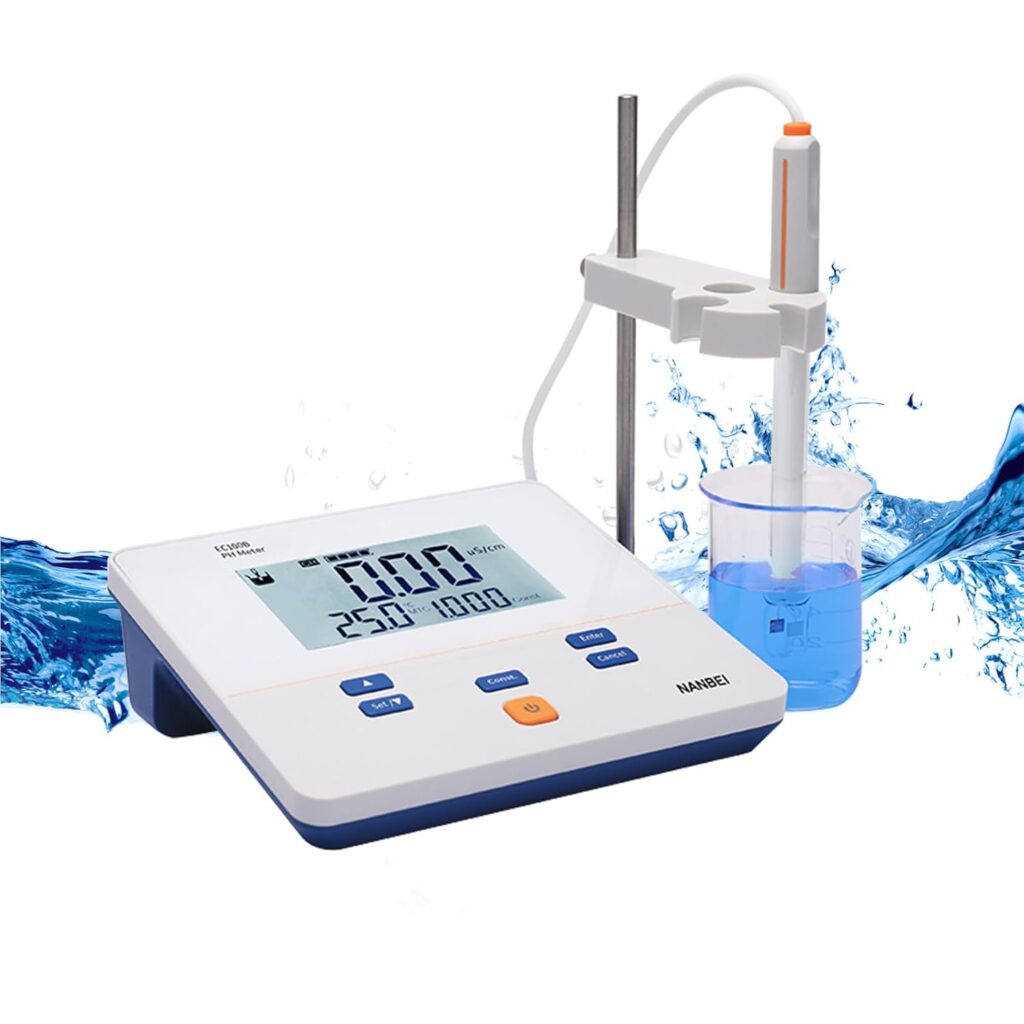
EC100B Benchtop Laboratory Conductivity Meter (Budget-Friendly Option)
The EC100B is a more affordable benchtop conductivity meter designed for routine laboratory conductivity testing. While it does not offer the same advanced data handling or multi-parameter flexibility as higher-end models, it remains a practical choice for teaching labs and basic water conductivity measurements.
⭐ Key Features
Conductivity Range: 0.00 μS/cm to 100.0 mS/cm for standard lab solution testing
Large LCD Interface: 6-inch display screen for clear bench-top readability
Manual Temperature Compensation: Adjustable temperature correction for more reliable results
IP54 Protection: Spill-proof, dust-proof, and durable for daily lab environments
Power Outage Protection: Retains settings and resumes operation after interruptions
Reset Function: Factory default restore option for shared laboratory use
⭐ Pros
Affordable price point compared to professional research-grade models
Large, easy-to-read display suitable for student laboratories
IP54-rated housing provides solid protection for routine bench work
Simple operation with manual temperature compensation support
⭐ Cons
Lower accuracy (±1.5% FS) compared to higher-end benchtop meters
Manual temperature compensation requires more user attention during measurements
Limited advanced features (no large data logging or GLP-level reporting)
Best suited for routine testing rather than high-precision research workflows
⭐ Lab Test Result
In practical laboratory use, the EC100B performs well for basic conductivity checks such as classroom experiments, general water quality screening, and routine solution preparation. Its main advantage is accessibility and simplicity, making it a reasonable entry-level benchtop meter for labs that do not require high-end accuracy or extensive data management.
The EC100B is a budget-friendly benchtop conductivity meter with a large LCD display and IP54 protection, ideal for basic laboratory conductivity measurements.
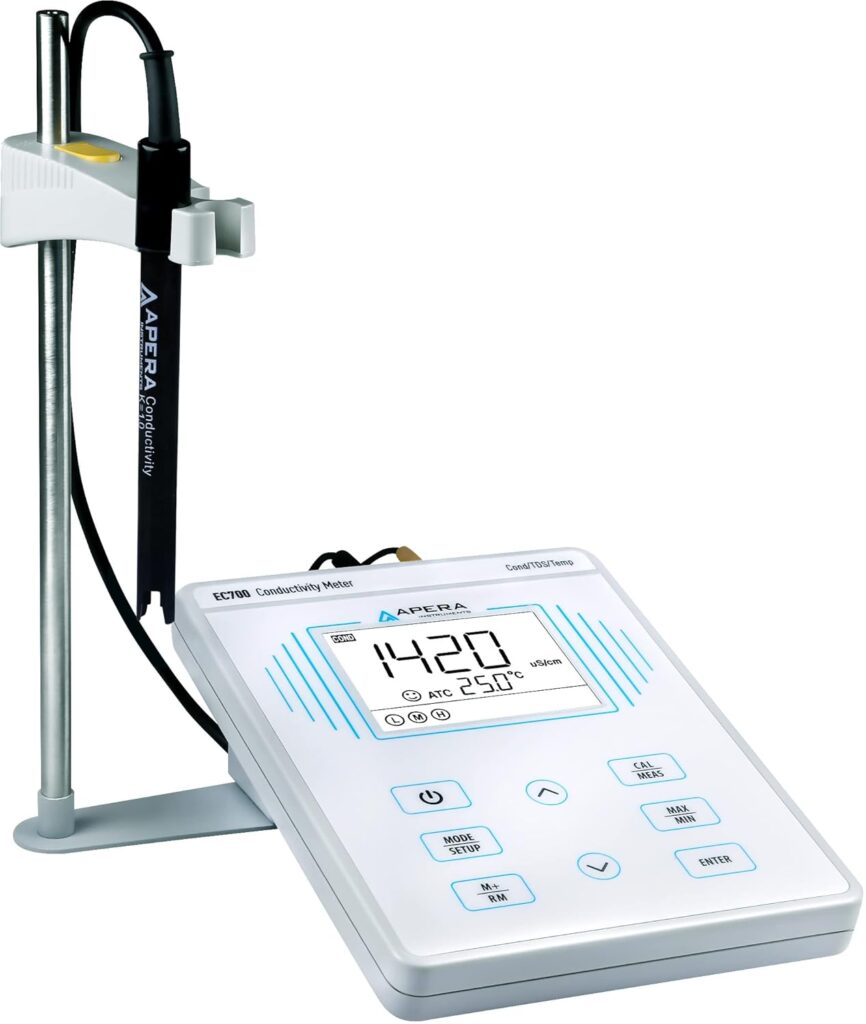
Apera Instruments AI502 EC700 Benchtop Conductivity Meter
The Apera AI502 EC700 is a well-balanced benchtop conductivity meter designed for laboratories that need reliable EC and temperature measurements without moving into premium high-cost research systems. With its advanced auto-calibration mode, stable digital processing, and a high-quality platinum black electrode, it is a strong option for university teaching labs and routine research workflows.
⭐ Key Features
Conductivity Range: 0–200.0 mS/cm, suitable for most chemistry and water testing applications
Accuracy Performance: ±1% FS accuracy for consistent daily laboratory measurements
Platinum Black ATC Electrode: Measures conductivity and temperature simultaneously with improved stability
1–4 Point Auto Calibration: Guided calibration mode with self-diagnosis for reliable setup
Fast and Stable Readings: Advanced digital processing technology reduces fluctuation in routine use
Complete Lab Package: Includes detachable electrode holder and pre-mixed calibration solutions
Lab-Ready Protection: IP54 spill-proof and dust-proof housing for bench-top durability
⭐ Pros
Recognized brand with strong reliability in university and professional lab environments
High-quality platinum black electrode improves measurement stability
Auto calibration with diagnostic guidance makes it easy for multi-user labs
Comes as a ready-to-use kit with calibration solutions included
Excellent balance between affordability and professional-grade performance
⭐ Cons
Accuracy is solid, but still below top-tier flagship research meters
Range may be unnecessary for labs working only with ultrapure water applications
Plastic housing feels less premium compared to high-end metal-bodied instruments
⭐ Lab Test Result (Practical Use)
In practical laboratory workflows, the AI502 EC700 performs as a dependable mid-range benchtop meter for routine conductivity testing, solution preparation, and teaching lab experiments. Its guided calibration system and stable electrode response make it particularly suitable for university labs where multiple users require repeatable, low-maintenance measurements.
The Apera AI502 EC700 combines auto-calibration, stable digital readings, and a platinum black ATC electrode, making it a strong mid-range choice for laboratory conductivity measurement.
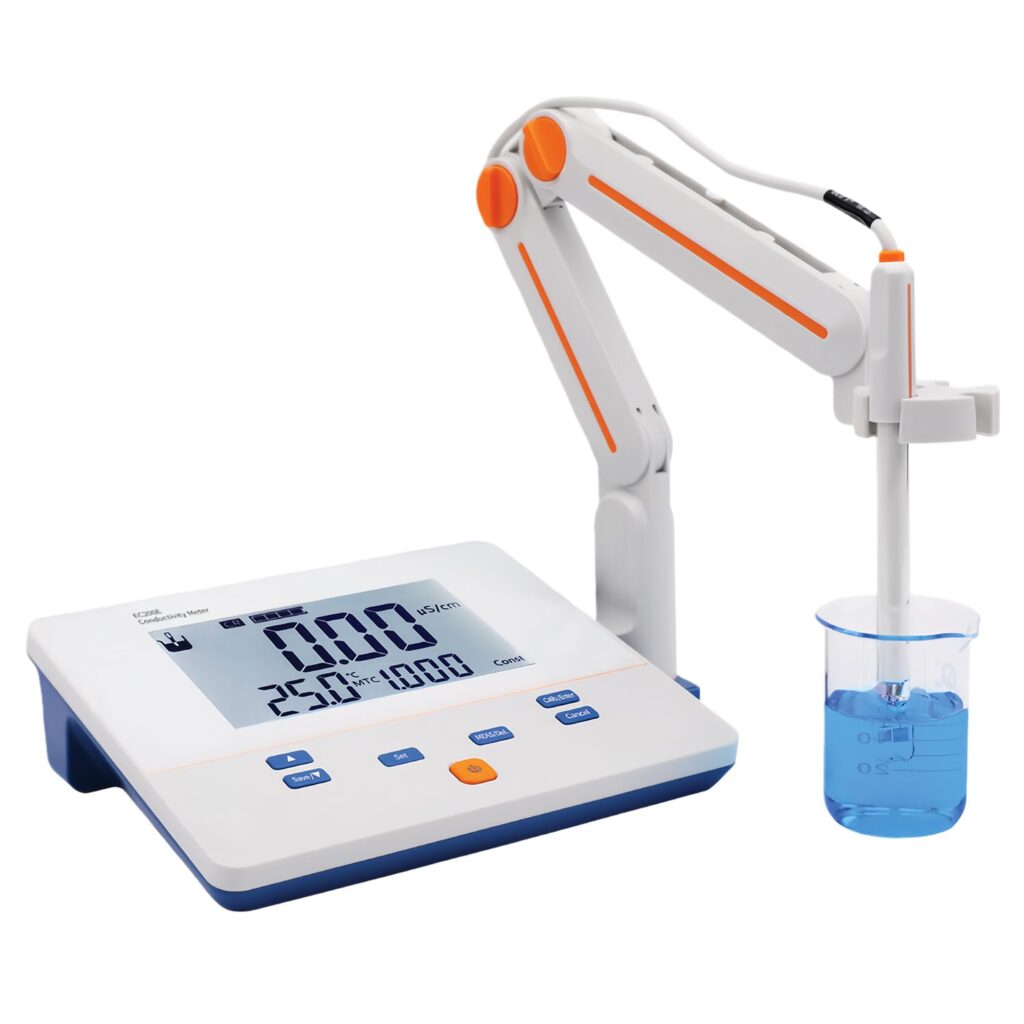
Supmea EC200E Digital Benchtop Conductivity Meter (Best Value Alternative)
The Supmea EC200E is a practical mid-budget benchtop conductivity meter built for laboratories that need stable routine EC and TDS measurements without investing in premium flagship systems. With both automatic and manual temperature compensation, a large LCD interface, and IP54 durability, it serves as a reliable value-focused option for teaching labs, water treatment testing, and general chemistry workflows.
⭐ Key Features
Expanded Measurement Range: 0.00 μS/cm to 200 mS/cm, suitable for most laboratory and water quality applications
Accuracy Performance: ±1.0% FS accuracy for consistent daily bench-top testing
Large 6-Inch LCD Screen: Clear readability with intuitive lab-friendly interface
Auto & Manual Temperature Compensation: Flexible correction modes for improved measurement reliability
Stable Endpoint Lock: Auto-hold function locks final readings for repeatable reporting
Durable Lab Housing: IP54 waterproof and dust-proof protection for routine bench use
Benchtop Long-Term Design: AC adapter support and stable form factor for continuous laboratory operation
⭐ Pros
Strong value option for labs needing mid-range performance at a lower cost
Supports both automatic and manual temperature compensation
Large display improves usability in shared teaching environments
IP54 protection adds durability for daily laboratory workflows
Auto-hold feature helps reduce reading variability during endpoint measurements
⭐ Cons
Not as widely established as premium brands for high-end research environments
Accuracy is solid for routine work but below flagship laboratory conductivity systems
Limited advanced reporting features compared with higher-tier data-logging models
⭐ Lab Test Result
In real laboratory use, the EC200E performs best as a dependable mid-budget benchtop meter for routine conductivity screening, solution preparation, and basic water treatment analysis. Its temperature compensation flexibility and stable auto-hold readings make it especially suitable for university labs that require practical performance without premium-level cost.
Supmea EC200E Benchtop Conductivity Meter — Value-Focused EC & TDS Testing for Routine Labs
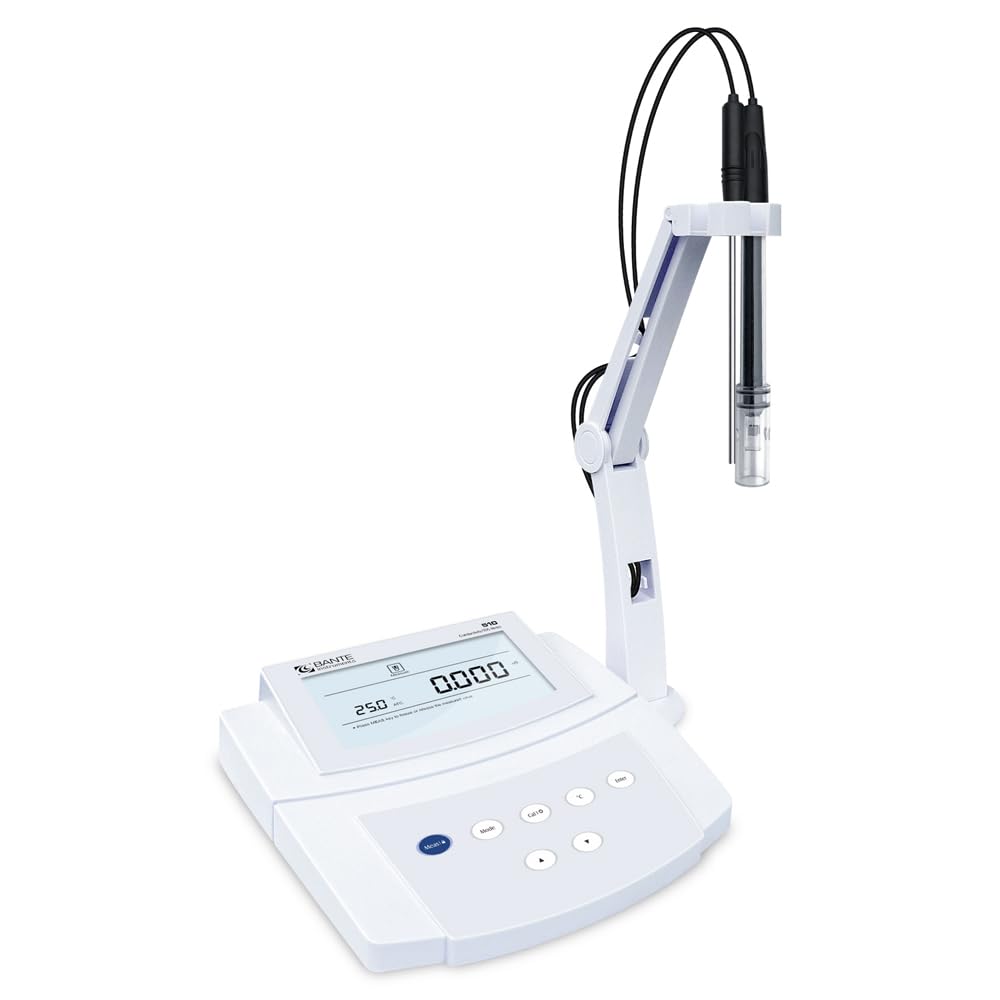
Bante 510 Benchtop Conductivity Meter (Best Classical Option for Teaching & Research Labs)
The Bante 510 is a classical benchtop conductivity and TDS meter designed specifically for research and educational laboratory environments. Equipped with platinum conductivity electrodes, reliable auto-read functionality, and a strong calibration system with standard recognition, it serves as a dependable mid-range choice for university teaching labs and routine solution analysis.
⭐ Key Features
Measurement Range: 0 to 200 mS/cm, suitable for most laboratory conductivity applications
Accuracy Performance: ±1% FS accuracy for stable routine EC measurements
Platinum Electrode Design: Equipped with platinum conductivity electrodes for reliable long-term performance
1–3 Point Calibration: Automatic recognition of common conductivity standards (10 µS/cm to 111.8 mS/cm)
Automatic Temperature Compensation: Corrects readings to a default reference temperature for consistency
Auto-Read Endpoint Lock: Senses and locks stable measurement values for repeatable reporting
Flexible Setup Menu: Allows adjustment of calibration points, temperature units, and system preferences
Reset Function: Factory default restore option for shared laboratory use
⭐ Pros
Well-suited for research and education-focused laboratory environments
Platinum electrodes provide stable and accurate measurements over time
Strong calibration standard recognition improves repeatability
Auto-read function is helpful for routine endpoint measurements
Reliable mid-range option for teaching labs and university procurement
⭐ Cons
More traditional interface compared to newer data-logging focused models
Limited advanced connectivity features compared with premium research meters
Best for routine lab workflows rather than ultra-high precision applications
⭐ Lab Test Result (Practical Use)
In practical laboratory workflows, the Bante 510 performs as a dependable bench-top meter for teaching experiments, solution preparation, and routine conductivity and TDS checks. Its platinum electrode stability and automatic calibration recognition make it especially useful in university labs where consistent measurements are needed across multiple users.
The Bante 510 is a reliable benchtop conductivity and TDS meter equipped with platinum electrodes, auto-calibration recognition, and temperature compensation for daily lab use.
How to Choose the Right Benchtop Conductivity Meter for Your Laboratory
How to Choose the Right Benchtop Conductivity Meter for Your Laboratory
Choosing the right benchtop conductivity meter for laboratory use is not simply about selecting the most expensive model or the widest measurement range. For most chemistry and physics laboratories, the best conductivity meter is the one that delivers consistent accuracy, reliable calibration, and practical usability in daily bench workflows.
Whether you are purchasing a laboratory conductivity meter for water testing, solution preparation, or routine quality control, the factors below will help you confidently select the right EC meter for your specific lab environment.
1. Measurement Range and Application Fit
The first step is matching the conductivity range to your typical samples. Some labs primarily test ultrapure or distilled water, while others work with highly conductive electrolyte solutions.
For general university labs, a range around 0–200 mS/cm is often sufficient.
For industrial or high-salinity testing, wider-range meters may be necessary.
A well-matched range prevents overpaying for unnecessary specifications while ensuring reliable performance across your workflow.
2. Accuracy and Long-Term Stability
In professional lab settings, accuracy is more than a number on a datasheet. A high-quality benchtop EC meter should maintain stable readings over repeated use, especially when multiple users share the same instrument.
Research and quality-control labs typically prioritize meters with accuracy around ±0.5% to ±1% FS, while entry-level teaching labs may accept slightly lower precision.
3. Calibration Options and Standard Recognition
Calibration is one of the most important daily tasks when using a digital conductivity meter for laboratory solutions. Models with multi-point calibration and automatic recognition of conductivity standards provide more repeatable results and reduce operator error.
Look for features such as:
3-point or 4-point calibration
Guided calibration modes
Auto-read endpoint locking for stable measurements
These functions are especially valuable in university procurement environments.
4. Temperature Compensation (ATC vs Manual)
Conductivity values are strongly temperature-dependent, which is why temperature compensation is essential for accurate reporting.
Automatic Temperature Compensation (ATC) is ideal for routine lab workflows.
Manual compensation may be acceptable for budget-focused teaching labs but requires more user attention.
For most professional buyers, a benchtop conductivity meter with ATC is the preferred choice.
5. Electrode Quality and Durability
The electrode is the core component of any laboratory water conductivity meter. Platinum black electrodes and rugged probe designs often provide faster response, improved stability, and longer service life.
For labs handling diverse samples — from low-conductivity water to saline solutions — probe reliability can significantly affect long-term usability.
6. Data Logging and Connectivity for Documentation
Modern research and quality-control laboratories increasingly require data traceability. If your lab needs reporting or integration with software, consider models offering:
Internal data storage
GLP support
USB or RS-232 connectivity
These features streamline documentation and make the instrument more suitable for professional laboratory environments.
Final Recommendation for Lab Buyers
The best benchtop conductivity meter for laboratory use is one that aligns with your lab’s measurement range, accuracy needs, calibration workflow, and reporting requirements. By focusing on practical performance rather than marketing claims, university labs and research facilities can make confident purchasing decisions that support long-term daily operation.
1. What is the best benchtop conductivity meter for laboratory use in 2026?
The best benchtop conductivity meter for laboratory usedepends on your lab’s accuracy needs and daily workflow. Research labs often prefer high-precision multi-parameter models, while university teaching labs may choose mid-range meters for routine EC testing.
2. How often should a laboratory conductivity meter be calibrated?
In most chemistry and water testing labs, calibration is typically performed daily or weekly, especially when accurate and repeatable results are required. Models with automatic standard recognition make frequent calibration easier.
3. Do benchtop conductivity meters measure TDS and salinity as well?
Yes. Many modern benchtop conductivity meters support additional parameters such as TDS, salinity, resistivity, and temperature, making them useful for water quality monitoring and solution analysis.
4. Is automatic temperature compensation (ATC) necessary for EC measurement?
Yes. Since conductivity values change with temperature, automatic temperature compensation (ATC) is strongly recommended for professional laboratory environments to ensure consistent and comparable readings.
5. What conductivity range is best for university chemistry and physics labs?
For most university laboratories, a conductivity range around 0–200 mS/cm is sufficient for common solution preparation and routine water testing. Wider ranges are mainly needed for high-salinity or industrial applications.
6. What is the difference between a benchtop conductivity meter and a portable EC meter?
A benchtop conductivity meter is designed for stable long-term laboratory use with better calibration support, higher precision, and advanced data handling. Portable meters are convenient for field work but are generally less suitable for demanding research workflows.
Conclusion: Choosing the Right Benchtop Conductivity Meter for Confident Lab Decisions
Selecting a benchtop conductivity meter is ultimately about matching the instrument to real laboratory workflows rather than chasing specifications alone. As the models reviewed in this guide show, different conductivity meters serve different roles across teaching labs, routine water quality testing, and research-focused environments.
High-precision multi-parameter meters are ideal for laboratories that require stable calibration performance and advanced reporting, while mid-range and value-focused models remain highly practical for shared university benches and day-to-day solution analysis. Understanding these differences helps avoid over-investment in unnecessary features while ensuring that critical measurement requirements are consistently met.
Before making a final purchasing decision, it is worth reviewing both the quick comparison table and the detailed evaluations carefully to identify the benchtop conductivity meter that best aligns with your laboratory’s sample types, accuracy needs, and long-term operational demands.