
introduction
Choosing the best educational microscope for students can be overwhelming — especially with so many models available in 2026. Whether you’re a school student, beginner, or parent looking for a reliable microscope, selecting the wrong one can lead to poor image quality and frustration.
In this guide, we’ve carefully selected the best educational microscopes for students based on magnification, ease of use, build quality, and value for money. From beginner-friendly models to more advanced options, you’ll find the right microscope for your needs.
If you’re building a student lab setup, you may also need tools like DC power supplies for electronics experiments.
Best Educational Microscopes for Students in 2026 (Comparison Guide)
Choosing the best educational microscope for students depends on several factors, including magnification range, ease of use, optical quality, and budget. Whether you’re looking for a beginner microscope for school students, a complete microscope kit for kids, or a professional laboratory microscope for advanced users, understanding the differences between models is essential.
In the comparison table below, we break down the best microscopes for students in 2026 — from affordable entry-level options to advanced trinocular and stereo microscopes — to help you quickly find the right choice based on your needs.
| Model | Woehrsh | AmScope T690C-PL | AmScope M150C | AmScope M162C | SW-2B13Z |
|---|---|---|---|---|---|
| Type | Trinocular | Trinocular | Monocular | Kit | Stereo |
| Magnification | 40X–5000X | 40X–2500X | 40X–1000X | 40X–1000X | 10X–60X |
| Best For | Advanced | Lab | Students | Kids | Hobby |
| Recommendation | 🔬 Best Value Advanced | 🧪 Best Professional | ⭐ Best Overall | 🎁 Best Starter Kit | 🔍 Best Stereo Option |
| price |
👉 Scroll down for detailed reviews of each microscope.
In-Depth Reviews of the Best Educational Microscopes for Students in 2026
To help you choose the best educational microscope for your needs, we’ve created detailed, hands-on reviews of each model listed above. Whether you’re looking for a beginner microscope for school students, a complete microscope kit for kids, or a professional trinocular or stereo microscope for advanced learning, this section breaks down everything you need to know.
Below, you’ll find in-depth analysis of each microscope, including real-world performance, ease of use, optical quality, and value for money — so you can confidently choose the right microscope for school, laboratory work, or home education.
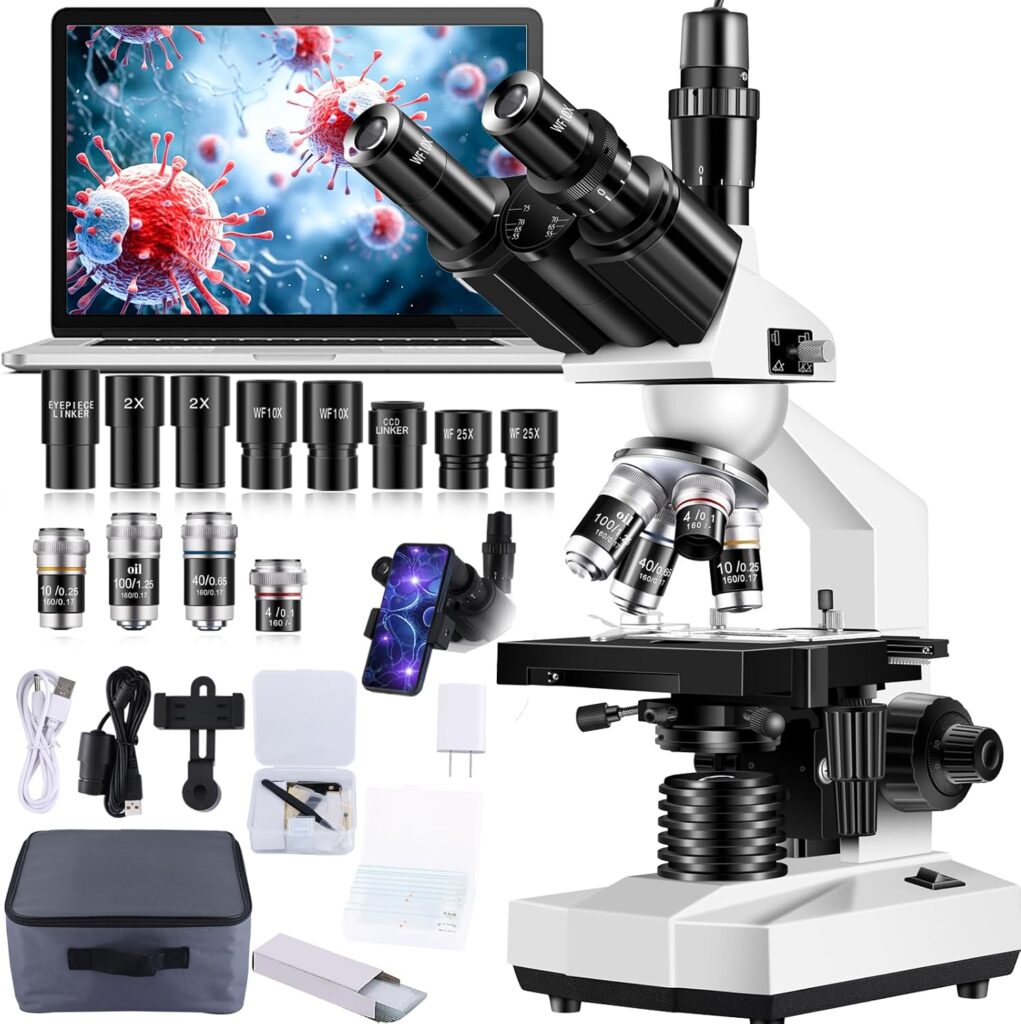
1. Woehrsh Trinocular Microscope (40X–5000X) Review
Key Features & Specs
- Magnification: 40X – 5000X
- Type: Trinocular Compound Microscope
- Camera: HD USB Digital Eyepiece
- Lighting: LED Illumination
- Objective Lens: Achromatic (Infinity Optical System)
- Eyepieces: WF10x & WF25x (Wide Angle)
- Stage: Dual-layer Mechanical Stage
- Head: 45° inclined, 306° rotatable
- Weight: ~4 kg
- Compatibility: Laptop (USB connection)
Pros
- Extremely high magnification (up to 5000X)
- Trinocular design → ideal for camera + real-time observation
- Comes with HD USB camera (great for documentation & teaching)
- Infinity optical system → sharper and clearer images
- Full lab kit included (slides, Petri dish, tools, etc.)
- Solid metal construction → durable for long-term use
Cons
- Not beginner-friendly (steep learning curve)
- Bulky and relatively heavy
- Overkill for basic school use
- The brand is less famous compared to AmScope or OMAX
Lab Performance Insight
This microscope is clearly designed for serious users rather than casual beginners.
Thanks to its trinocular head and HD camera support, it performs well in documentation, research, and advanced biology observations.
The infinity optical system significantly improves image clarity compared to standard student microscopes, especially at higher magnifications. However, reaching the upper limit (5000X) in real-world conditions may require optimal sample preparation and experience.
In short:
- Excellent for university students, lab work, and advanced learners
- Not ideal for kids or first-time users
Best For
- University students (biology, medical, materials science)
- Lab environments & research beginners
- Users who want digital imaging + microscope combo
- Advanced hobbyists
Not Recommended For
- Elementary or middle school students
- Simple classroom use
- Users looking for a quick plug-and-play microscope
Final Verdict
If you’re looking for a serious upgrade from basic student microscopes, the Woehrsh Trinocular Microscope is a strong choice.
It bridges the gap between educational microscopes and professional lab equipment, making it ideal for students who want to go beyond basic observation.
🔴🔗Price : 👉 Check Latest Price on Amazon
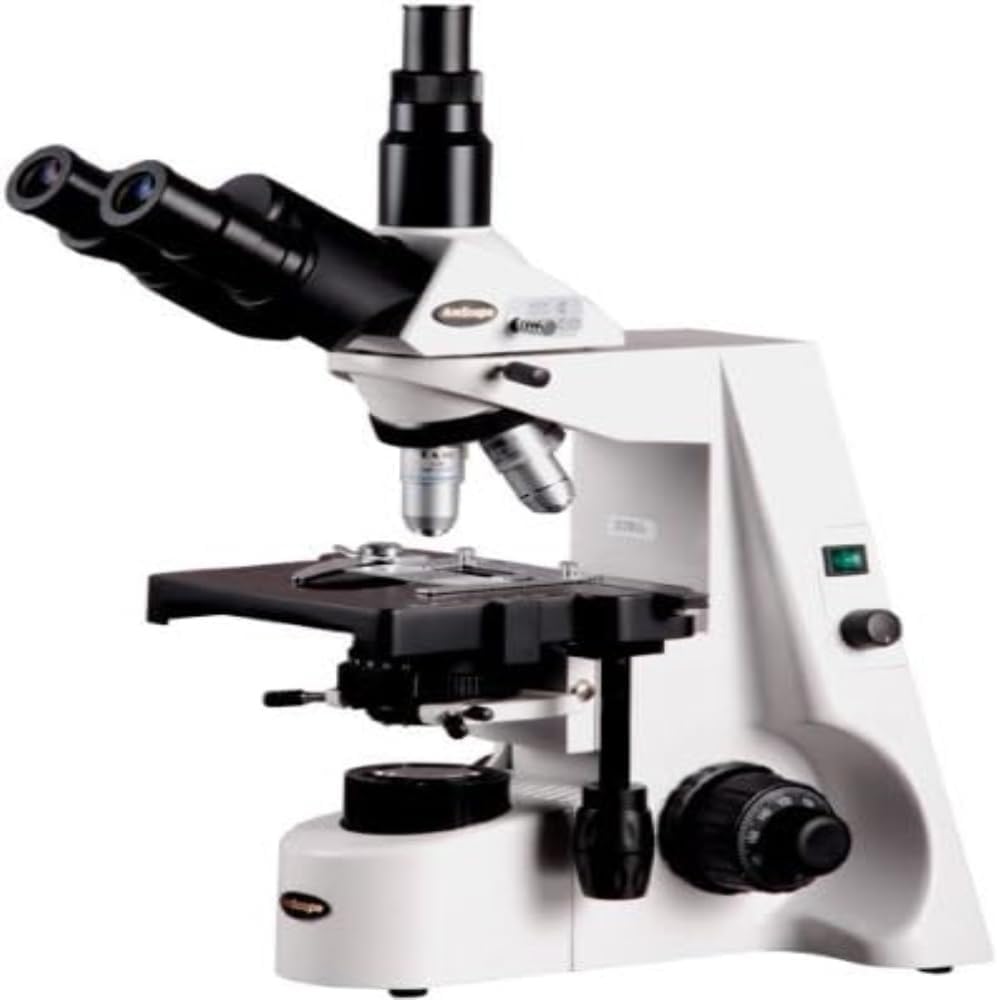
2. AmScope T690C-PL Trinocular Microscope Review
While most students don’t need this level of performance, investing in a professional microscope like this can significantly improve observation accuracy and learning outcomes.
Key Features & Specs
- Magnification: 40X – 2500X
- Type: Trinocular Compound Microscope
- Optics: Infinity Plan Achromatic Objectives
- Eyepieces: WH10x & WH25x Super Widefield
- Illumination: Halogen (with rheostat control)
- Condenser: Köhler illumination system
- Stage: Double-layer Mechanical Stage
- Head: 30° inclined, 360° rotatable
- Interpupillary Distance: 55–75 mm
- Brand: AmScope
Pros
- Infinity plan optics → extremely sharp, flat-field imaging
- Köhler illumination → professional-level light control
- Trinocular head → perfect for camera & documentation
- Excellent for biological and lab applications
- Durable and reliable brand (AmScope = trusted)
- Smooth and precise focusing system
Cons
- Expensive for most students
- Requires some experience to use properly
- Halogen light (not LED) → more heat + maintenance
- Not portable
Lab Performance Insight
This microscope is far beyond a typical educational microscope.
The combination of plan achromatic objectives and Köhler illumination delivers highly uniform, sharp, and contrast-rich images — especially important for serious biological observation.
Compared to entry-level student microscopes, the difference in image quality is very noticeable, particularly when working with detailed specimens or oil immersion (100x objective).
In real lab conditions:
- Excellent for university labs, research beginners, and advanced biology students
- Overkill for basic school learning
Best For
- University students (biology, medical, lab sciences)
- Research labs
- Advanced users upgrading from basic microscopes
- Users who need high-quality imaging + camera setup
Not Ideal For
- Kids or beginners
- Casual home use
- Budget buyers
Comparison Insight
Compared to the Woehrsh microscope:
- AmScope T690C-PL → better optics & precision (PRO level)
- Woehrsh → cheaper & more beginner-accessible
Final Verdict
If you’re serious about microscopy and need lab-grade performance, the AmScope T690C-PL is one of the best choices in this price range.
👉 It’s not just an educational microscope —
it’s a bridge to professional laboratory work.
🔴🔗Price : 🔬 Check Latest Price on Amazon
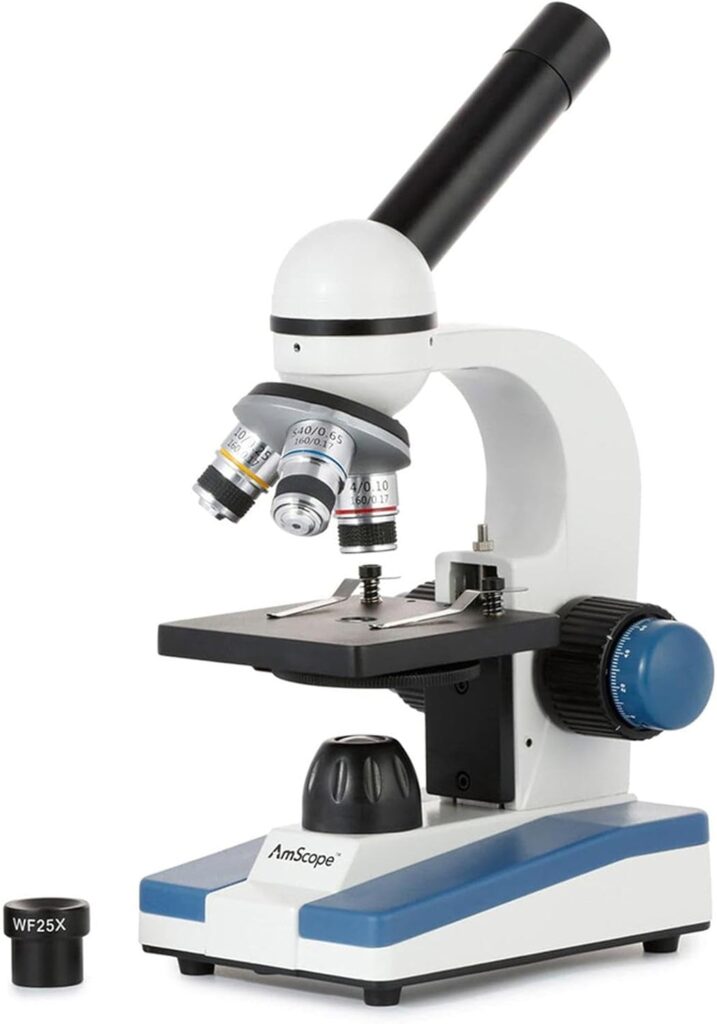
3. AmScope M150C Microscope Review
This is one of the most popular microscopes for students due to its balance of price, durability, and ease of use.
Key Features & Specs
- Magnification: 40X – 1000X
- Type: Monocular Compound Microscope
- Illumination: LED (Corded + Battery)
- Head: 360° Rotatable
- Build: All-metal frame
- Power: Adapter or AA batteries
Pros
- Very easy to use for beginners
- Affordable price (great value)
- Durable all-metal construction
- LED light → low heat & energy efficient
- Portable (battery option)
Cons
- Monocular → not ideal for long sessions
- Limited advanced features
- Not suitable for professional lab work
🔬 Lab Performance Insight
This microscope is one of the best entry-level options for students.
It provides enough magnification (up to 1000X) for most school-level experiments, including basic biology observations.
While it doesn’t offer advanced optical systems like professional microscopes, it delivers clear and reliable images for beginners, making it perfect for learning.
Best For
- Elementary & high school students
- Beginners in microscopy
- Home education / homeschool
- Budget buyers
Not Ideal For
- University research
- Advanced lab work
🛒 Final Verdict
If you’re looking for a reliable, affordable, and beginner-friendly microscope, the AmScope M150C is one of the best choices available in 2026.
🔴🔗Price : 🔬 Check Latest Price on Amazon
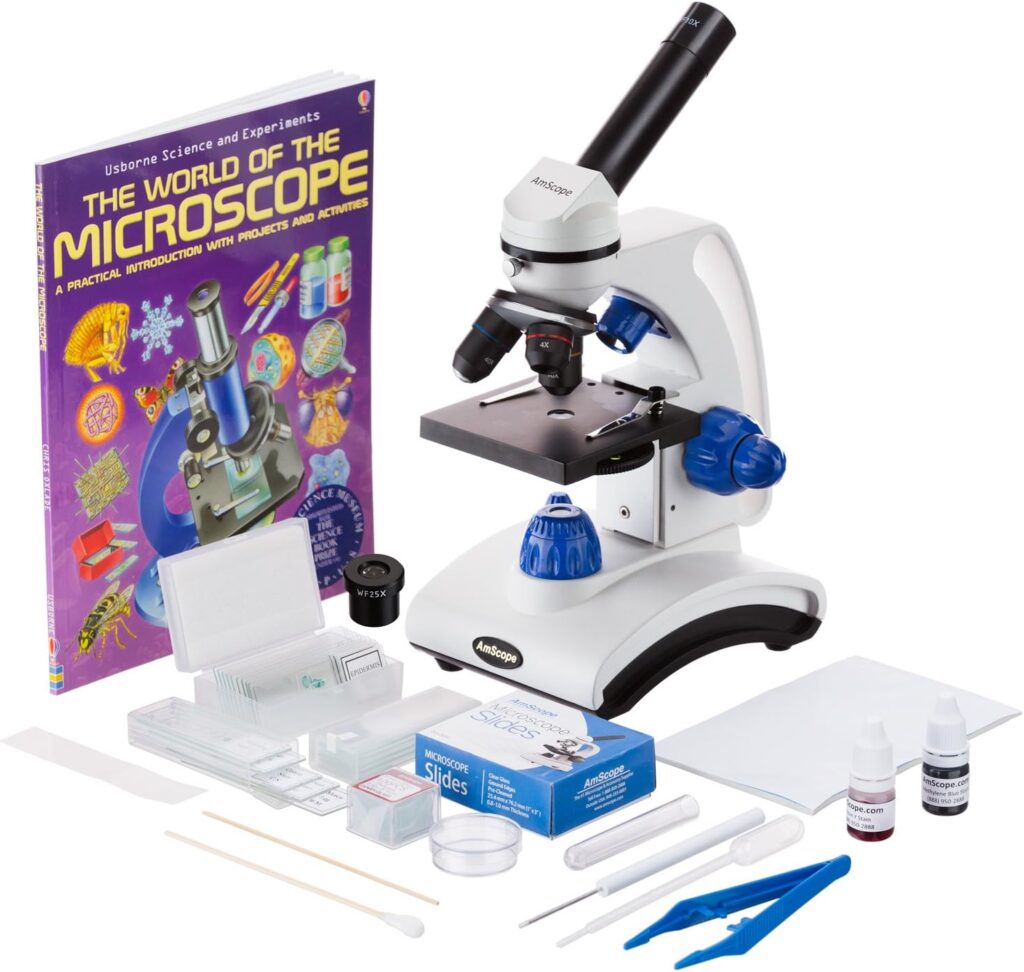
4. AmScope M162C Microscope Kit Review
This is not just a microscope — it’s a complete beginner kit designed for learning and exploration.
Key Features & Specs
- Magnification: 40X – 1000X
- Type: Monocular Compound Microscope
- Lighting: Dual LED (top & bottom)
- Power: Adapter or AA batteries
- Extras: Slides, tools, book, accessories
- Build: Metal frame
Pros
- Complete starter kit (everything included)
- Great for kids and beginners
- Dual LED lighting → more flexibility
- Easy to use
- Good educational value
Cons
- Not as sharp as higher-end models
- Accessories are basic quality
- Not suitable for advanced users
Lab Performance Insight
This microscope is designed more as an educational starter kit rather than a precision instrument.
It works well for introducing students and kids to microscopy, allowing them to explore basic specimens and learn fundamental concepts. However, compared to standalone microscopes like the M150C, the optical quality is slightly lower.
👉 In short:
- Great for learning & exploration
- Not ideal for serious study
Best For
- Kids & young students
- Beginners with no experience
- Parents buying a science gift
- Home learning
Not Ideal For
- High school advanced biology
- University use
- Research
🛒 Final Verdict
If you’re looking for a complete beginner microscope kit, the AmScope M162C is a great choice.
👉 It’s perfect for getting started — especially for younger students.
🔴🔗Price : 🔬 Check Latest Price on Amazon
5. AmScope SW-2B13Z Stereo Microscope Review
This microscope is not a replacement for a standard student microscope — it’s a complementary tool for observing larger, 3D specimens.
Key Features & Specs
- Magnification: 10X – 60X
- Type: Stereo (Dissecting) Microscope
- Eyepieces: WH10x
- Objective: 1X / 3X (with 2X Barlow lens)
- Lighting: Upper & Lower Halogen
- Head: Binocular, 45° inclined
- Stand: Pillar-style
- Use: Large specimens & 3D viewing
Pros
- Perfect for 3D observation
- Ideal for insects, rocks, electronics, jewelry
- Long working distance
- Dual lighting system
- Solid build quality
Cons
- Low magnification compared to compound microscopes
- Not suitable for cell-level biology
- Halogen light (heat + maintenance)
- Relatively heavy
Lab Performance Insight
Unlike compound microscopes, this stereo microscope provides a three-dimensional view of larger specimens.
It’s especially useful for students who want to observe objects that require manipulation — such as insects, plant parts, or small mechanical components.
👉 In practice:
- Great for hands-on learning
- Not suitable for microscopic cell analysis
Best For
- Students learning biology basics
- Hobbyists
- Insect & rock observation
- Electronics / repair work
Not Ideal For
- Advanced biology (cells, bacteria)
- High magnification needs
Final Verdict
If you want a different type of microscope for hands-on observation, the AmScope SW-2B13Z is an excellent choice.
It complements compound microscopes rather than replacing them.
🔴🔗Price : 🔬 Check Latest Price on Amazon
How to Choose the Best Microscope for Your Needs (Beginner to Advanced Guide)
Choosing the best microscope for your needs depends on several key factors, including your experience level, intended use, and budget. Whether you’re a beginner student, a parent buying a microscope for kids, or an advanced user looking for a laboratory-grade microscope, understanding what features matter most can help you make the right decision.
In this guide, we’ll break down the most important factors to consider when buying a microscope for students — from magnification and microscope type to lighting and build quality — so you can confidently choose the best option for school, lab work, or home learning.
1. Choose Based on Your Skill Level
If you’re a beginner or a school student, a simple and easy-to-use microscope like a monocular compound microscope is the best choice. These models offer sufficient magnification for basic biology and are more affordable.
For intermediate or advanced users, trinocular or stereo microscopes provide more flexibility, better optics, and additional features like camera support and 3D observation.
2. Understand the Different Types of Microscopes
There are several types of microscopes available, and each serves a different purpose:
- Compound microscopes are ideal for observing cells and microorganisms.
- Stereo microscopes are better for viewing larger objects like insects, plants, or electronic components.
- Trinocular microscopes are designed for advanced users who need camera integration and professional-level observation.
Choosing the right type is one of the most important steps when selecting a microscope.
3. Magnification: How Much Do You Really Need?
Many beginners assume that higher magnification is always better, but that’s not always true. For most students, a magnification range of 40X to 1000X is more than enough for school-level biology.
Higher magnification microscopes (like 2000X or more) are typically used in advanced laboratory settings and may not be necessary for beginners.
4. Lighting System: LED vs Halogen
The lighting system plays a crucial role in image clarity. LED lighting is energy-efficient, long-lasting, and ideal for beginners. Halogen lighting, on the other hand, offers brighter illumination and better control, making it suitable for advanced users and laboratory work.
5. Build Quality and Ease of Use
A good student microscope should be durable, stable, and easy to operate. Models with all-metal construction tend to last longer, while features like smooth focusing knobs and adjustable heads improve usability.
6. Budget: Finding the Right Value
Microscopes come in a wide range of prices, from budget-friendly options under $100 to professional models costing over $1000. For most students, a mid-range microscope offers the best balance between performance and affordability.
Choosing the right microscope is not about getting the most expensive model — it’s about finding the one that best fits your learning needs and experience level.
For advanced experiments, students may also require precision tools such as LCR meters to measure electrical properties accurately.
Final Thoughts: Which Educational Microscope Should You Choose in 2026?
Choosing the best educational microscope for students ultimately depends on your experience level, learning goals, and budget. For most beginners and school students, a reliable and easy-to-use microscope like the AmScope M150C offers the best balance between performance and affordability.
If you’re buying for younger learners, a complete microscope kit can provide a more engaging and hands-on experience. On the other hand, advanced students and university users may benefit from trinocular or laboratory-grade microscopes with higher optical quality and camera support.
The key is to choose a microscope that matches your needs — not just the highest magnification or the most expensive option.
👉 Our recommendation: Start with a beginner-friendly microscope, and upgrade as your skills and requirements grow.
👉 Compare all models above and choose the best microscope for your needs today. Jump to In-Depth Reviews.
Frequently Asked Questions About Student Microscopes
The best microscope for students depends on their level. For beginners, a compound microscope with 40X–1000X magnification is usually the best choice due to its ease of use and affordability.
Most students only need a magnification range between 40X and 1000X. Higher magnification is typically unnecessary for school-level learning and may complicate usage.
Digital microscopes can be useful for displaying images on a screen and recording observations. However, traditional optical microscopes often provide better clarity and are preferred for educational purposes.
Compound microscopes are used to observe small specimens like cells, while stereo microscopes are designed for larger objects and provide a 3D view.
Beginners should look for a microscope that is easy to use, durable, and offers a magnification range of up to 1000X. LED lighting and simple controls are also important features.
🔗 Related Articles